
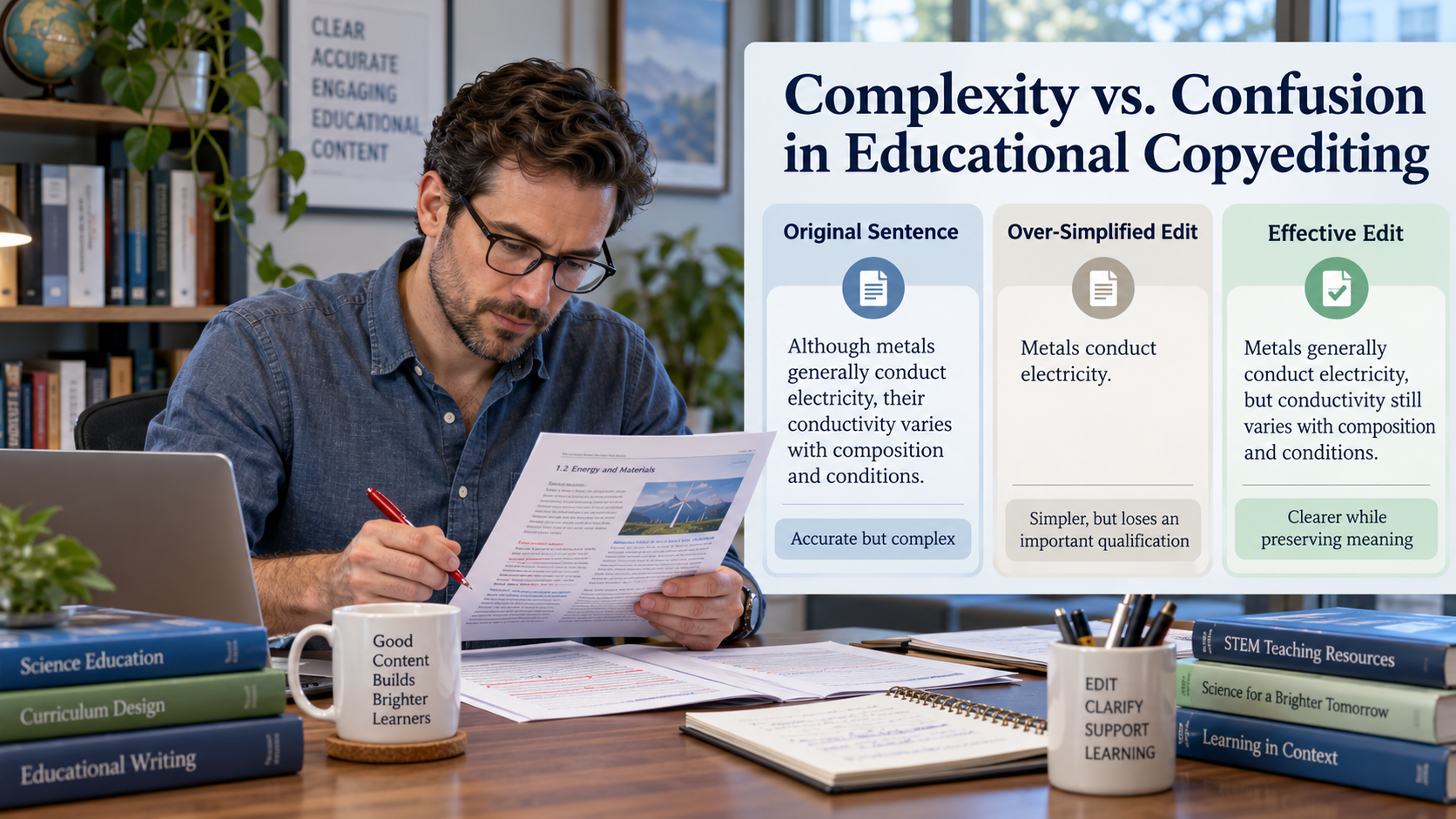
A sentence in an educational module can be grammatically correct and still be difficult for learners to understand. It may contain several subordinate clauses, qualifications, and technical details that compete for attention. Simplifying it might improve readability, but an overly aggressive edit could remove an important condition, change the relationship between concepts, or weaken the instructional emphasis.
For educational publishers, EdTech companies, and digital learning teams, this presents a specific copyediting challenge: how can editors improve complex sentence structures without changing the meaning, instructional intent, or intended tone of the content?
This requires more than correcting grammar. Editors must understand how sentence structure shapes the relationship between ideas, directs attention, introduces exceptions, and controls the order in which learners receive information.
In this article, deep narrative syntax is used as a practical editorial lens for examining those relationships. Although the term is not a standardized category of educational copyediting, the underlying principles are relevant to academic content, textbooks, assessment items, technical explanations, and digital learning materials.
What Is Deep Narrative Syntax?
Syntax refers to how words, phrases, and clauses are arranged within a sentence. In educational content, sentence structure influences how learners interpret explanations, follow instructions, and distinguish a main idea from supporting information.
Deep narrative syntax, as used here, examines how these structural choices affect meaning, emphasis, tone, and the sequence in which information is presented.
Consider this example:
Although photosynthesis requires light energy to convert carbon dioxide and water into glucose and oxygen, the rate of the process also depends on factors such as temperature and carbon dioxide availability.
The sentence contains a subordinate clause followed by a main clause. The opening establishes the process, while the main clause introduces additional factors affecting its rate.
If an editor shortens the sentence without preserving this relationship, learners may lose the distinction between the requirements of photosynthesis and the factors that influence its rate.
For educational content, the relevant questions are therefore not simply whether a sentence is long or complicated, but whether its structure communicates the intended relationship between ideas.
Three dimensions of complex sentence editing
- Logical relationships: Does the sentence clearly distinguish cause and effect, contrast, conditions, and exceptions?
- Instructional emphasis: Does the sentence direct attention to the concept learners need to understand?
- Reading flow: Can learners follow the sentence without losing track of the main idea?
These dimensions matter across educational content, whether the material explains a scientific process, introduces a historical development, presents a mathematical rule, or specifies the conditions for answering an assessment question.
Why Complex Sentences Matter in Educational Content
Complex sentences are not inherently difficult to understand. They can express relationships that would otherwise require several disconnected statements. The challenge is to use them without overloading the reader or obscuring important information.
1. They establish relationships between concepts
Educational explanations often need to connect multiple ideas within a single sentence.
For example:
Because the force acting on an object is unbalanced, the object accelerates in the direction of the net force.
The subordinate clause establishes the condition, and the main clause states the resulting outcome.
An editor who separates these ideas must preserve the causal relationship. A revision such as “An object experiences an unbalanced force. The object accelerates.” is shorter, but the relationship between the statements is less explicit.
The appropriate edit depends on the learners’ level, the surrounding explanation, and whether the causal connection is already clear.
2. They distinguish rules from exceptions
Educational and technical content frequently includes qualifications. These may be essential to accurate understanding.
Consider:
Although metals generally conduct electricity because they contain mobile charge carriers, their conductivity varies depending on their composition and physical conditions.
The opening clause establishes a general principle, while the main clause qualifies it.
Removing the qualification or rewriting the sentence carelessly could turn a general statement into an absolute claim. In STEM content, that kind of change may introduce a substantive error rather than simply altering the writing style.
Copyeditors should identify which clauses express the core principle and which define its limits.
3. They control the order in which learners encounter information
The order of clauses can guide learners from a familiar concept to a new one, introduce a condition before presenting a result, or establish a contrast before explaining its significance.
For example:
When a government increases taxes to reduce demand, the policy may lower consumption, although its overall effect depends on how households and businesses respond.
The sentence first presents a policy condition, then a possible outcome, and finally a qualification.
An editor might split the sentence to improve readability for younger learners. However, the revised version should preserve the relationship between the policy, its possible effect, and the uncertainty of the outcome.
4. They help maintain an appropriate instructional tone
Educational writing should be clear without becoming unnecessarily abrupt or repetitive.
Compare:
Learners should compare the two ecosystems, identify differences in their food webs, and explain how changes in one population may affect other organisms.
With:
Learners should compare the two ecosystems. They should identify differences in their food webs. They should explain how changes in one population may affect other organisms.
Both versions are grammatical. The first presents a coordinated sequence of tasks, while the second gives each task separate emphasis.
For a concise activity instruction, the first may be more effective. If learners need to complete each stage independently, the second might better suit the instructional design.
The choice should reflect the task and audience, not a blanket preference for shorter or longer sentences.
The Copyeditor’s Challenge: Distinguishing Complexity From Confusion
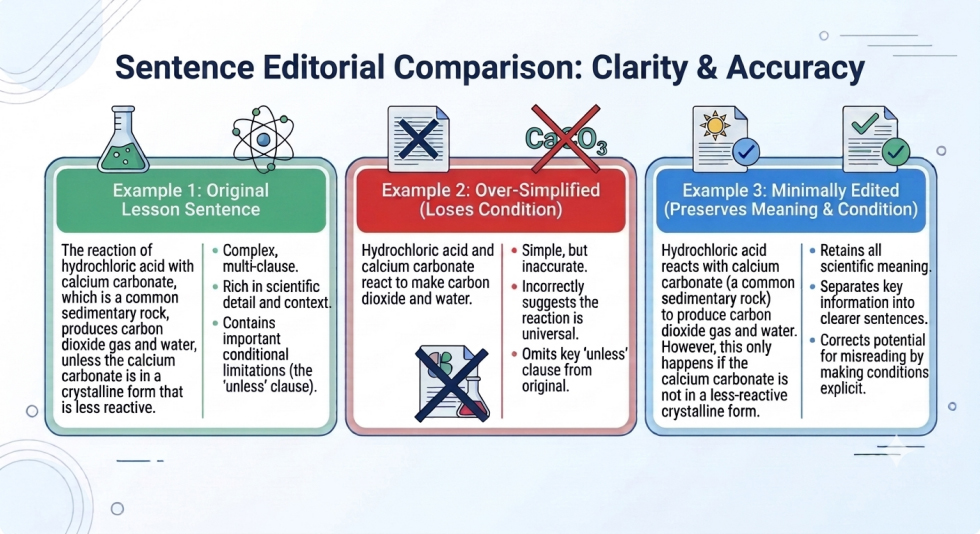
A central editorial skill is recognizing when a sentence needs correction and when its structure is appropriate for the intended purpose.
When a complex sentence is working
A sentence may be effective when:
- The relationship between its clauses is clear.
- Each clause contributes to the necessary information.
- Conditions and exceptions remain easy to identify.
- The sentence reflects the appropriate level of complexity for the audience.
- The structure supports the learning objective or task.
When a complex sentence needs attention
An edit may be necessary when:
- The main idea is buried under too many qualifications.
- A pronoun could refer to more than one concept.
- A modifier appears to describe the wrong subject.
- The connection between cause and effect is unclear.
- A condition or exception could be mistaken for the main rule.
- The sentence combines too many instructions without a clear sequence.
Consider this example:
After comparing the two graphs, the conclusion was that the temperature increased.
The introductory phrase suggests that the conclusion compared the graphs. The sentence has a dangling modifier.
A clearer version is:
After comparing the two graphs, the learners concluded that the temperature increased.
The correction resolves the grammatical problem without changing the intended task.
Now consider:
Although the sample was heated gradually, and although the temperature was recorded at regular intervals, the results showed no measurable change in volume.
The sentence is structurally complex, but the clauses establish the procedure and the result. It may be appropriate in a scientific explanation or report. Splitting it could improve accessibility for some learners, but that decision should account for the intended reading level and surrounding text.
Complexity is not automatically an error. The editorial goal is to make the intended meaning accessible without changing it.
Five Techniques for Editing Complex Sentences in Educational Content
1. Identify the main idea
Before revising a sentence, identify the proposition or instruction learners must understand.
Example:
Although renewable energy sources can reduce dependence on fossil fuels, their availability varies according to geographical conditions and weather patterns.
The main point is that renewable energy availability varies. The opening clause supplies the broader context.
An editor should preserve both ideas while ensuring that the sentence’s emphasis matches the lesson’s purpose.
2. Check the relationship between clauses
Determine whether each clause expresses a cause, result, condition, contrast, example, or qualification.
Example:
If a solution contains more dissolved solute than it can normally hold at a given temperature, the solution is described as supersaturated.
The opening clause establishes a condition, and the main clause names the resulting state.
If an edit changes if to because, the logical relationship changes. Such substitutions require attention to meaning, not just sentence flow.
3. Preserve conditions and qualifications
Conditions often carry important technical information.
Original:
Students may use the formula to calculate acceleration when the net force and mass are known.
Potentially problematic revision:
Students can calculate acceleration using the formula.
The revision removes the stated condition. It may be acceptable in a broader introductory context, but it is less precise if the lesson is teaching students which information they need to perform the calculation.
Copyeditors should avoid deleting qualifications merely to shorten a sentence.
4. Review sentence length in context
There is no single sentence length that works for every audience or subject. A sentence that is appropriate for advanced learners may overwhelm younger readers or learners who are new to the subject.
Consider:
When the water reaches its boiling point at the given atmospheric pressure, the added energy is used to change the liquid into vapor rather than to increase its temperature.
For an introductory lesson, this could be split:
At a given atmospheric pressure, water boils at its boiling point. During boiling, added energy changes the liquid into vapor rather than increasing its temperature.
The revised version makes the sequence more explicit. However, the scientific meaning must still be checked, and the appropriate wording depends on the course’s level and terminology.
5. Make the smallest effective edit
When a sentence is unclear, begin by identifying the specific problem. It may require a punctuation change, a clearer pronoun, a reordered phrase, or a division into two sentences.
Avoid rewriting the entire passage if a small change will resolve the issue.
If the sentence appears to contain a conceptual error, do not silently change the technical meaning. Flag it for a subject-matter expert (SME) or raise a query for the content owner.
A Practical Framework for Sentence-Level Editorial Decisions
The following framework can help copyeditors make consistent decisions across educational manuscripts, digital modules, and assessment content.
| Editorial question | Potential issue | Recommended action |
| Is the sentence grammatically incorrect? | Agreement, modifier, punctuation, or clause-structure error | Correct the construction while preserving meaning |
| Is the main idea difficult to identify? | Excessive subordination or competing information | Clarify the sentence or divide it where appropriate |
| Does the sentence express a condition or exception? | Revision could change the rule’s scope | Preserve and verify the qualification |
| Is the relationship between ideas clear? | Cause, contrast, or sequence may be ambiguous | Adjust the connective or clause order |
| Is the wording appropriate for the intended learners? | Reading complexity may exceed the intended level | Simplify selectively without removing necessary concepts |
| Does the sentence appear technically inaccurate? | A language edit alone may not resolve the issue | Refer it for SME review |
| Would the edit change the intended learning task? | Instructions or cognitive demand may shift | Check alignment with the learning objective and assessment requirements |
This framework is useful because it separates language problems from instructional and technical concerns. A sentence can be grammatically correct but still misrepresent a concept, omit a necessary condition, or give learners an unclear task.
Preserving Consistency Across Large Educational Content Projects
When several editors work on the same textbook series, course library, or assessment bank, their decisions should follow shared principles. Otherwise, similar sentences may be handled differently across modules, even when the intended audience and content type are the same.
A practical workflow includes:
- Define the editing scope. Clarify whether the project requires copyediting, stylistic editing, or substantive revision.
- Document style conventions. Establish preferences for sentence structure, terminology, punctuation, headings, and instructional language.
- Identify audience requirements. Define the expected reading level and the amount of technical language learners are expected to understand.
- Use representative samples. Agree on how complex sentences should be handled before editing the full content batch.
- Escalate content concerns. Route possible scientific, mathematical, historical, or assessment errors to qualified reviewers.
- Conduct editorial QA. Review samples or complete batches for clarity, consistency, adherence to the brief, and preservation of meaning.
- Update guidance when patterns recur. If the same issue appears repeatedly, revise the instructions or examples provided to editors.
For assessment content, this process should also protect the intended skill being measured. Simplifying a question must not inadvertently remove a condition, reveal the answer, or change the level of reasoning required.
Can AI Help Edit Complex Sentences?
AI-assisted editing tools can identify long sentences, suggest simpler alternatives, flag possible ambiguity, and help compare revisions. These functions can support first-pass review of large educational content collections.
However, a recommendation to shorten a sentence does not establish that the original sentence is defective. Automated tools may remove important qualifications, change technical terminology, or alter the relationship between a question and its intended answer.
A balanced workflow assigns different responsibilities:
- AI tools: Flag potential readability issues and suggest alternative constructions.
- Copyeditors: Check grammar, clarity, terminology, instructional tone, and consistency with the style guide.
- Subject-matter experts: Verify technical claims and resolve conceptual questions.
- Instructional designers or assessment specialists: Check whether revisions preserve the learning objective, task requirements, and intended cognitive demand.
AI can accelerate the identification of possible issues, but human review remains necessary when an edit could change the instructional meaning.
Copyediting and Editorial QA at Ankyrin Solutions
For educational publishers, EdTech companies, and digital learning providers, sentence-level editing must support both language quality and instructional accuracy.
Ankyrin Solutions can support relevant projects through:
- Copyediting and editorial QA: Reviewing grammar, clarity, sentence structure, consistency, and adherence to project-specific style guides.
- Academic and educational content development: Helping maintain clear explanations and appropriately structured learning materials.
- STEM and technical content review: Flagging terminology issues, unclear technical explanations, and potential inaccuracies for appropriate review.
- Assessment development and review: Checking question wording, instructions, answer options, and rationales for clarity and consistency.
- AI-generated content review: Evaluating AI-assisted educational material for accuracy, readability, and editorial quality.
The appropriate level of intervention depends on the audience, subject, content format, and project brief. For large projects, a pilot batch can help establish editing conventions and review criteria before work expands across a complete content library.
Conclusion
Complex sentence structures can help educational content explain relationships, preserve important conditions, and guide learners through a sequence of ideas. They become a problem when their structure obscures meaning or creates unnecessary cognitive demands.
Effective copyediting does not mean shortening every sentence. It means identifying what the sentence needs to communicate, correcting genuine problems, and preserving the distinctions learners must understand.
Contact Ankyrin Solutions to discuss copyediting and editorial QA support for educational, academic, STEM, or assessment content. We can help define an appropriate review workflow for pilot batches as well as large-volume projects.