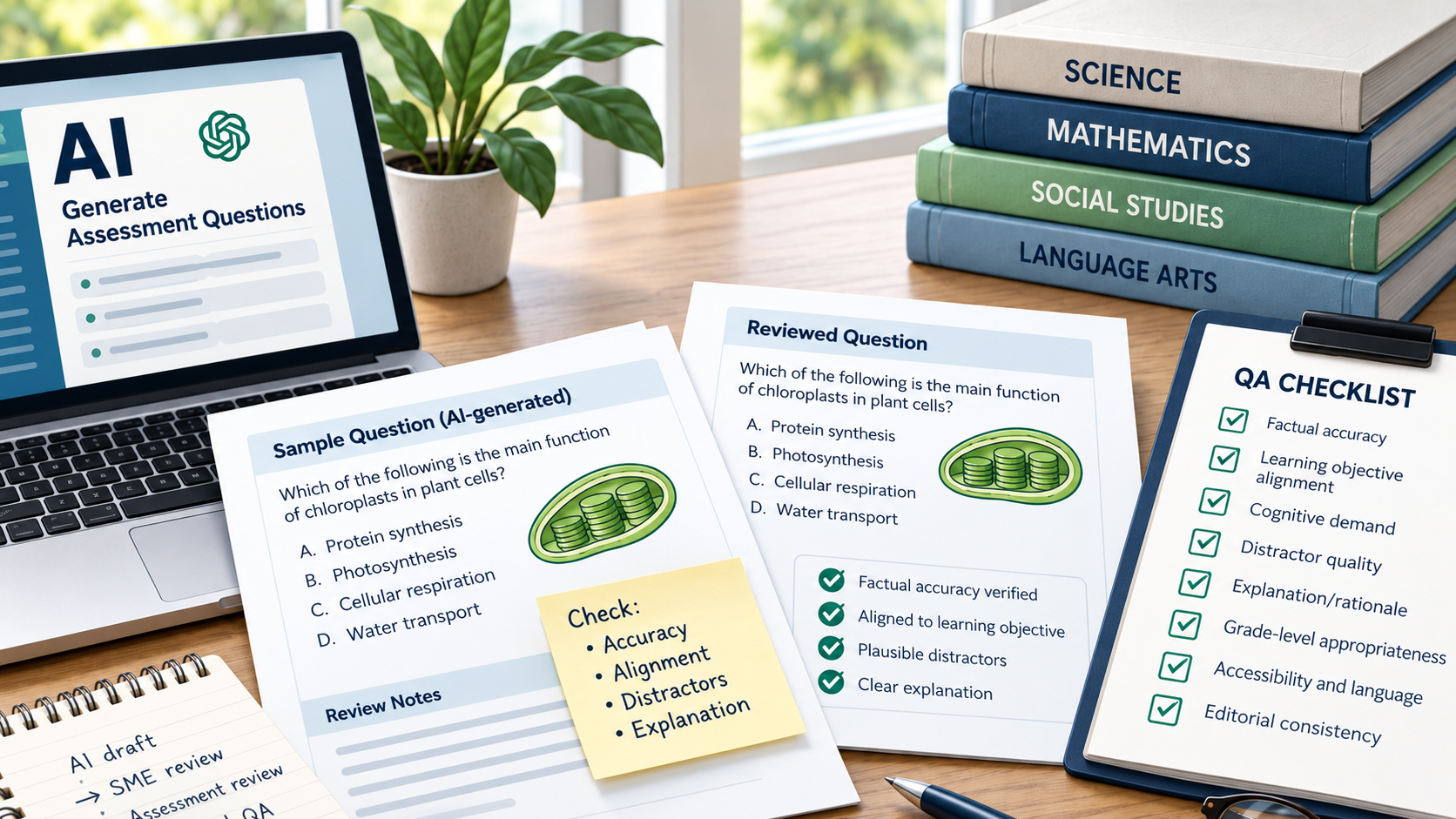
AI can generate hundreds of assessment questions in the time it takes a content team to write a small batch manually. But a larger question bank is not necessarily a better one. Questions may contain factual errors, test the wrong learning objectives, include implausible distractors, or appear appropriate for a grade level while demanding skills students have not yet learned.
For educational publishers and EdTech companies, these problems can become expensive when they go unnoticed until late in production. An incorrect answer key may require revisions across multiple products. A poorly aligned question bank can weaken the connection between lessons and assessments. Inconsistent item quality can also create additional work for editors, reviewers, and instructional designers.
The solution is not to reject AI-assisted assessment development. It is to establish a quality assurance (QA) process that treats AI-generated questions as drafts requiring validation, not finished products ready for publication.
This guide explains how educational publishers, assessment companies, and digital learning teams can build a practical review workflow that supports production at scale without compromising educational quality.
Why AI-Generated Assessment Questions Need Human Review
AI tools can help generate question stems, answer options, explanations, and variations of existing items. They can also assist with categorization and preliminary alignment with learning objectives.
However, generating a question and establishing that it measures learning effectively are two different tasks.
A question can be grammatically correct but conceptually inaccurate. It can mention the right topic without testing the intended skill. It can have one correct answer while giving that answer away through an obvious wording pattern.
Consider a science publisher developing questions for a middle-school unit on photosynthesis.
A generated question might ask students to define photosynthesis. This is suitable if the learning objective is to recall the process. However, if students are expected to interpret experimental results, a definition question will not provide sufficient evidence of that ability.
The distinction matters: topic coverage is not the same as learning-outcome coverage.
The 1EdTech Consortium’s AI-Generated Content Best Practices highlights the importance of responsible AI use in educational content. Transparency, accountability, and subject-matter expert validation are relevant considerations for publishers distributing assessments across multiple subjects, grade levels, and platforms.
Human review should therefore examine more than spelling and factual accuracy. It should establish whether each question serves its intended educational purpose.
7 Quality Checks for AI-Generated Assessment Questions
A useful QA framework evaluates each item against a defined set of criteria. The following checks can be adapted to formative assessments, textbook question banks, digital practice exercises, and formal tests.
1. Verify Factual and Subject-Matter Accuracy
Start by checking the question stem, answer options, correct answer, explanation, and supporting data.
AI-generated content can contain incorrect facts, flawed calculations, outdated information, or explanations that sound convincing without being accurate. These risks vary by subject.
- Mathematics: Independently verify calculations, formulas, and worked solutions.
- Science: Check terminology, scientific relationships, units, and interpretations of diagrams or experiments.
- History and social sciences: Assess chronology, context, and whether a question oversimplifies a complex issue.
AI-generated mathematics items can contain fluent, well-formatted explanations with an incorrect intermediate calculation. Because the reasoning may look convincing at first glance, language-only review is not enough.
Example: A question asks students to calculate the area of a rectangle measuring 8 cm by 5 cm. The answer key gives 26 cm².
The question is straightforward, but the answer is incorrect. The correct area is 40 cm².
A basic language review would not necessarily catch this error. Subject-matter review and independent answer verification would.
2. Check Alignment with Learning Objectives and Curriculum Standards
Every assessment item should have a clear purpose.
Reviewers should ask:
- Which learning objective does the question assess?
- Does the item measure the intended knowledge or skill?
- Is the required content within the scope of the relevant curriculum?
- Does the question require knowledge students were expected to learn?
- Is the item appropriately placed within the unit or course?
Where a publisher uses a formal curriculum or standards framework, alignment should be checked against the applicable version and the specific requirements of the target market.
Example: A learning objective asks students to compare fractions using visual models. An AI-generated question asks them to convert fractions into decimals and compare the results.
Both questions concern fractions, but they do not assess the same skill. Unless decimal conversion is also an intended outcome, the generated item needs revision.
This is why matching keywords to curriculum topics is insufficient. Alignment must account for the actual cognitive task students are expected to perform.
3. Evaluate Cognitive Demand
Assessment quality depends partly on the thinking a question requires.
A question bank may cover every topic in a chapter while testing little beyond recall. Conversely, a question intended for introductory practice may demand reasoning beyond the learner’s current level.
Reviewers can use Bloom’s taxonomy or Depth of Knowledge (DOK), where appropriate, to describe the kind of thinking required. These frameworks serve different purposes and should not be treated as interchangeable measures of difficulty.
Bloom’s taxonomy helps classify cognitive processes, such as remembering, applying, and analyzing. DOK considers the complexity of thinking and knowledge required to complete a task.
Neither framework determines item quality on its own. The question must still match the learning objective and intended audience.
| Intended learning outcome | Suitable assessment approach | What to check |
| Recall key terms | Definition or identification question | Accuracy and clarity |
| Apply a formula | Numerical problem with relevant data | Correct method and answer |
| Interpret evidence | Data table, graph, or experiment | Reasoning and evidence use |
| Compare explanations | Structured comparison or scenario | Relevance and depth of reasoning |
For publishers developing large question banks, cognitive-demand tagging can help identify gaps. However, tags generated by AI should be reviewed against the actual task, not accepted based on the question’s wording alone.
4. Review Distractors and Answer Options
Multiple-choice questions require one correct answer and several plausible incorrect options. The incorrect options, known as distractors, should be plausible enough to make the question meaningful without creating ambiguity.
AI may produce distractors that are obviously wrong, unrelated to the question, or accidentally correct under a reasonable interpretation.
Reviewers should check whether:
- Only one answer is correct, unless the item explicitly allows multiple answers.
- Distractors reflect plausible misconceptions or errors.
- Options are grammatically consistent with the question stem.
- The correct answer is not noticeably longer or more detailed than the others without a good reason.
- Options do not overlap or reveal the answer through wording.
- Negative phrasing and qualifiers are used clearly.
Example: A question asks students to identify the result of multiplying 6 by 7. The options are 42, 500, 1,000, and 2,400.
Although only one option is correct, the distractors are so implausible that the item may offer little useful discrimination among learners who understand multiplication at this level.
A stronger set might include 36, 42, 48, and 56, provided the intended audience and instructional context make these plausible alternatives.
Good distractors are not merely wrong answers. They are carefully constructed alternatives that help assess whether learners understand the concept.
5. Validate Answer Keys, Rationales, and Marking Schemes
The answer key must match the question, and the rationale must explain why the answer is correct.
For multiple-choice questions, rationales should ideally address relevant misconceptions. For open-ended questions, the marking scheme should clarify the evidence required for credit.
For example, a question asking students to explain why plants need sunlight should not receive a model answer that merely states that sunlight is important. The explanation should reflect the intended scientific concept and the expected depth of understanding.
Reviewers should also check for:
- Contradictions between the answer key and explanation.
- Missing steps in mathematical solutions.
- Unsupported claims in model answers.
- Mark allocations that do not reflect the expected response.
- Acceptable alternative answers that the marking scheme overlooks.
This check is especially important when content will be used for automated feedback. An incorrect rationale can reinforce a misconception even when the answer key is correct.
6. Check Accessibility, Clarity, and Audience Appropriateness
An assessment item should allow learners to demonstrate the intended skill without introducing unnecessary barriers.
Reviewers should consider reading level, sentence structure, terminology, cultural assumptions, and the accessibility of any supporting media.
For digital assessments, this may include checking whether instructions work with assistive technologies and whether images or diagrams have appropriate text alternatives. When an image contains essential information, its alternative text or accessible equivalent must preserve the information needed to answer the question.
Accessibility requirements should be evaluated against the relevant product specifications and applicable standards.
The review should also distinguish between language difficulty and subject difficulty. Complex wording should not make a straightforward science question unnecessarily difficult unless reading comprehension is being assessed.
7. Check Consistency Across the Question Bank
An individual question may pass every content check and still create problems when published alongside hundreds of other items.
Large assessment projects need consistent rules for terminology, punctuation, units, answer-option formatting, difficulty labels, feedback, and metadata.
Editorial QA should identify inconsistencies such as:
- Different terms used for the same concept.
- Inconsistent capitalization and hyphenation.
- Mixed measurement units without a clear rationale.
- Duplicate or near-duplicate questions.
- Repeated patterns that reveal correct answers.
- Missing curriculum tags or item identifiers.
A shared style guide, metadata schema, and review checklist can help different writers and reviewers apply the same standards across production batches.
A Practical QA Workflow for Assessment Development
Quality assurance works best when it is built into the production process rather than treated as a final proofreading stage.
A publisher or EdTech company can use the following workflow.
Step 1: Define the Assessment Specification
Document the learning objectives, target audience, item types, expected cognitive demand, curriculum requirements, and output format.
Step 2: Generate or Draft the Questions
Use AI or human writers to create a first batch of items based on the approved specification. Include answer keys, rationales, and relevant metadata.
Step 3: Conduct Automated and Editorial Checks
Flag missing fields, duplicate wording, formatting issues, inconsistent tags, and possible answer-key mismatches. Automated flags should be treated as review prompts, not final judgments.
Step 4: Obtain Subject-Matter and Assessment Review
Check factual accuracy, alignment, cognitive demand, distractor quality, rationales, and marking criteria.
Step 5: Complete Final QA and Approval
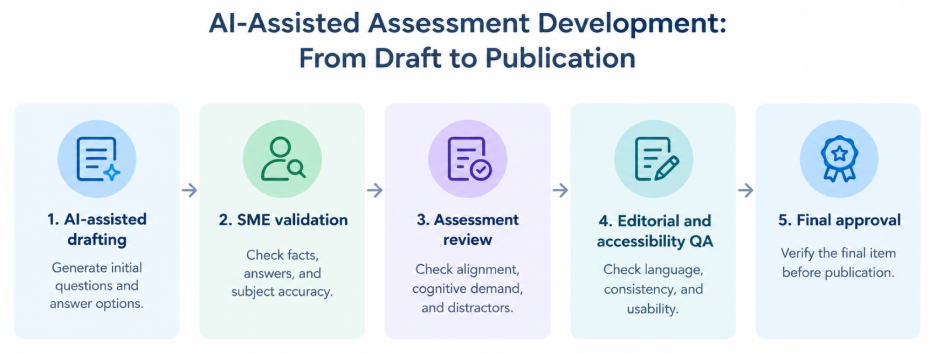
Resolve review comments, confirm accessibility and editorial consistency, verify the final files, and record approval before publication.
Use a Review Matrix to Standardize Decisions
A simple review matrix makes responsibilities clearer and helps teams track recurring problems.
| QA dimension | Primary reviewer | Required evidence |
| Subject accuracy | Subject-matter expert (SME) | Verified content and answers |
| Curriculum alignment | Curriculum specialist or instructional designer | Objective-to-item mapping |
| Cognitive demand | Assessment specialist | Justified cognitive-demand classification |
| Distractors and rationales | Assessment specialist and SME | Plausible options and defensible explanations |
| Accessibility and clarity | Accessibility or editorial reviewer | Completed review against project criteria |
| Style and formatting | Copyeditor or editorial QA reviewer | Compliance with the style guide |
| Final completeness | Project QA lead | Resolved comments and approved deliverables |
One person may perform several roles on a smaller project. For specialized, high-stakes, or technically complex assessments, independent review may be warranted.
The goal is to make review criteria explicit and repeatable rather than rely on individual judgment alone.
Can AI Help with Assessment Quality Assurance?
AI can support several parts of the review process, particularly when publishers need to process large volumes of content. However, the value depends on how the tools are used and whether their outputs are independently checked.
Where AI Can Help
AI-assisted workflows can help teams:
- Flag possible factual inconsistencies for investigation.
- Compare questions against supplied learning objectives.
- Identify duplicate or near-duplicate items.
- Check whether required fields, answer keys, and rationales are present.
- Suggest alternative distractors or clearer question wording.
- Identify inconsistent terminology and formatting.
- Produce preliminary summaries of reviewer feedback.
These tasks can reduce repetitive work and help reviewers focus on more complex decisions.
Where Human Expertise Remains Necessary
AI-generated assessments still require qualified reviewers to determine whether the content is accurate, educationally appropriate, and fit for publication. For example, an AI tool might label a question as requiring analysis because its stem contains the word “analyze.” But the question may simply ask learners to recall a fact. A human reviewer must evaluate the actual thinking required.
Similarly, automated checks may identify a mathematically unusual answer but fail to understand a valid alternative solution. In technical subjects, an apparently minor terminology error may change the meaning of an entire question.
A practical division of responsibilities is:
| Task | Appropriate role for AI | Human responsibility |
| Duplicate detection | Identify potential matches | Confirm whether items assess the same skill |
| Objective mapping | Suggest possible alignments | Validate alignment against the intended outcome |
| Answer verification | Flag inconsistencies and check calculations | Independently verify correctness |
| Language review | Suggest edits and flag inconsistencies | Preserve meaning, context, and appropriate terminology |
| Cognitive-demand tagging | Suggest preliminary classifications | Confirm the cognitive task |
| Final approval | Compile QA results | Accept or reject items for publication |
AI should make the review process more efficient, not remove the need for educational judgment.
Common Mistakes to Avoid When Reviewing AI-Generated Questions
Even teams with established editorial workflows can overlook problems when production volumes increase. The following mistakes are worth addressing explicitly.
Treating grammatical correctness as proof of quality: A polished question can still contain an incorrect answer or assess the wrong skill. Content review must precede final language approval.
Checking topic coverage instead of learning outcomes: A question about the right chapter may not measure the objective assigned to it. Reviewers should evaluate what learners must actually do to answer it.
Accepting AI-generated metadata without verification: Difficulty labels, cognitive-demand tags, and curriculum mappings can be useful, but they are not reliable simply because they are consistently formatted.
Reviewing questions individually but ignoring the question bank as a whole: Duplicate items, uneven cognitive demand, repetitive distractors, and gaps in coverage may only become apparent across a larger batch.
Leaving QA until the end of production: Late-stage corrections can affect answer keys, rationales, formatting, platform uploads, and other dependent materials. Early review reduces the risk of propagating errors.
Using the same review depth for every item: A low-risk practice question and an item used for certification or consequential decisions may require different levels of scrutiny. Review effort should reflect the intended use, subject complexity, and potential consequences of an error.
A Pre-Publication Checklist for AI-Generated Assessment Questions
Before approving an assessment batch, use the following checklist to confirm that the essential checks have been completed.
Assessment QA Checklist
- Every item maps to a defined learning objective.
- The question and answer key are factually correct.
- Calculations, units, and worked solutions have been verified where applicable.
- The cognitive demand matches the intended outcome and audience.
- Distractors are plausible and do not create ambiguity.
- Rationales and marking schemes support the expected answers.
- Language, reading level, and terminology are appropriate.
- Accessibility requirements for text, media, and interaction have been reviewed.
- Duplicate items and gaps in assessment coverage have been checked.
- Style, formatting, metadata, and required fields are consistent.
- Reviewer comments have been resolved, and final approval is recorded.
This checklist provides a starting point. Publishers should adapt it to their curriculum, assessment format, delivery platform, and risk requirements. High-stakes assessments may need additional validation, formal approval procedures, and evidence that the items perform as intended.
Assessment Development Services at Ankyrin Solutions
Developing and reviewing assessment content at scale requires a combination of subject knowledge, assessment expertise, instructional design, and editorial consistency. For organizations managing multiple products or large content pipelines, maintaining these capabilities entirely in-house may not always be practical.
Ankyrin Solutions can support publishers, EdTech companies, digital learning providers, and educational content teams with relevant assessment and academic content workflows.
Depending on the client workflow, Ankyrin can act as the primary assessment-development team, an independent QA layer, or a subject-matter expert and editorial review partner for AI-generated content.
Support may include:
- Assessment development: Creating questions and assessment materials aligned with defined learning objectives and project specifications.
- Question writing and distractor development: Developing assessment items with plausible answer options and appropriate cognitive demand.
- Rationale and answer-key review: Checking explanations, correct answers, and supporting assessment materials.
- Curriculum and standards alignment: Reviewing content against the specified curriculum, learning outcomes, or standards.
- Subject-matter expert review: Evaluating technical and academic accuracy in subject-specific content.
- Copyediting and editorial QA: Improving clarity, grammar, terminology, style consistency, and production readiness.
- AI-generated content review: Evaluating AI-assisted educational content for accuracy, alignment, clarity, and consistency before publication.
The appropriate combination depends on the project. A publisher preparing a new question bank may need end-to-end assessment development, while an EdTech company with an existing AI-generation pipeline may primarily need independent content validation and editorial QA.
A pilot batch can help establish review criteria, identify recurring issues, and define an efficient workflow before scaling a larger production volume.
Contact Ankyrin Solutions to discuss your assessment development or content QA requirements.
Conclusion
AI-generated assessment questions can help publishers and EdTech companies expand content production, but speed alone does not establish quality. Every item must still be evaluated for accuracy, alignment with learning objectives, cognitive demand, distractor quality, accessibility, and editorial consistency.
The most effective approach combines AI-assisted drafting and routine checks with structured human review. By defining clear acceptance criteria, assigning review responsibilities, and checking content at both the item and question-bank levels, organizations can build more reliable assessment-production processes.
For educational publishers, the goal is not simply to produce more questions. It is to produce assessments that measure the intended learning outcomes and are ready for learners to use.