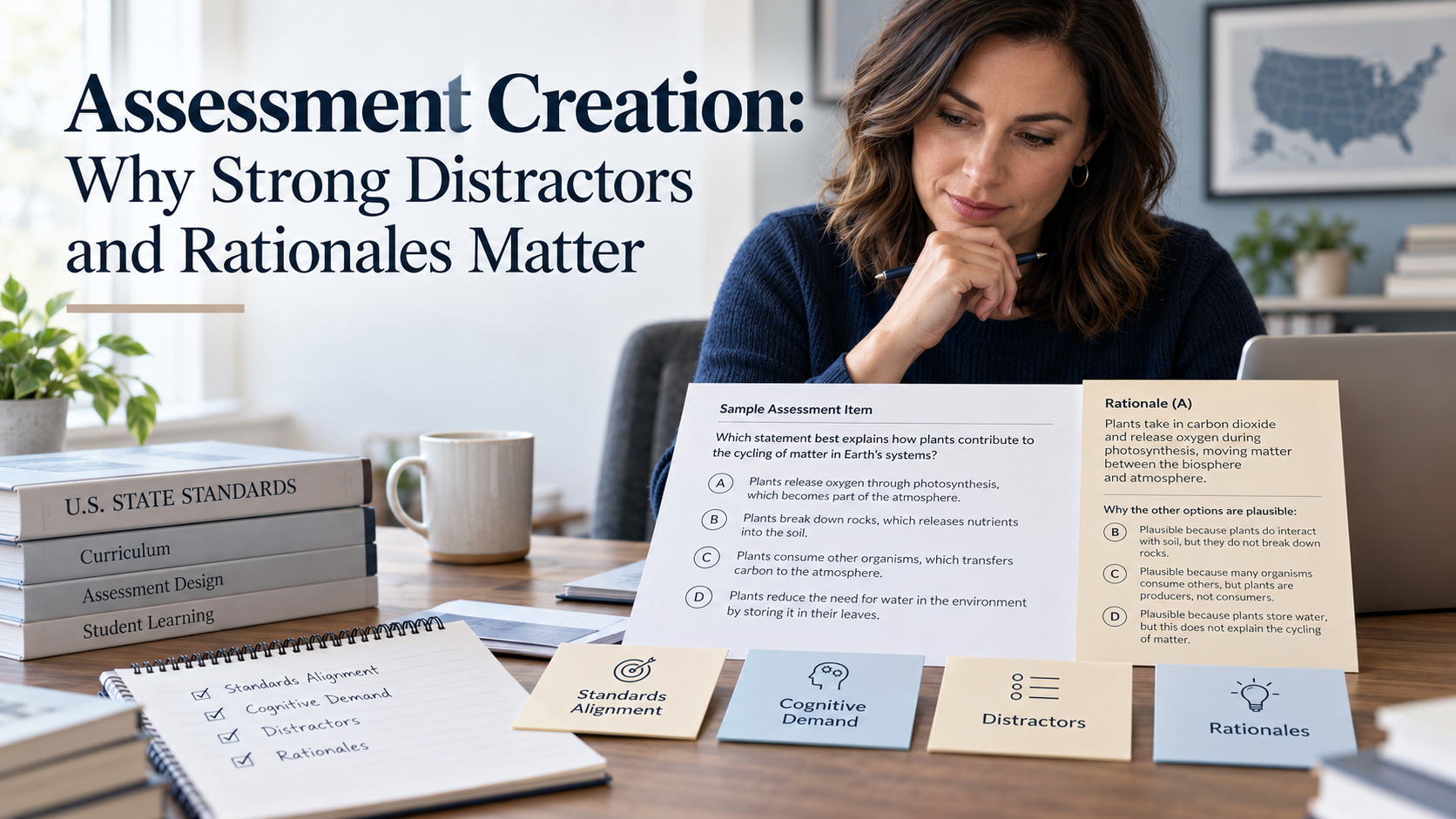
Assessment development for U.S. state standards is not simply a matter of writing a question and adding four answer choices. A strong state-aligned assessment item must measure the intended standard, target the appropriate level of cognitive demand, use grade-appropriate language, avoid unintended clues, and distinguish between students who understand the concept and those who do not.
For publishers, EdTech companies, curriculum developers, and assessment providers, maintaining these requirements becomes particularly important when developing hundreds or thousands of items across different grades, subjects, and state frameworks.
At Ankyrin Solutions, our assessment development services support standards-aligned item creation and review across K–12 subjects. Two elements that deserve particular attention are distractors and rationales. When designed properly, they help ensure that questions measure the intended learning outcomes and provide meaningful evidence of student understanding.
What Makes U.S. State Assessment Development Different?
The United States does not operate under a single K–12 academic standards framework. States may adopt, adapt, or create their own standards and assessment requirements. An item developed for one state therefore cannot automatically be reused in another simply because the subject and grade are the same.
Assessment developers may need to consider:
- Texas Essential Knowledge and Skills (TEKS)
- State-specific science standards based on or influenced by the Next Generation Science Standards (NGSS)
- State English language arts and mathematics standards
- State assessment blueprints and item specifications
- Cognitive-demand expectations such as Depth of Knowledge (DOK)
- State-specific item types, accessibility requirements, and scoring rules
The first step in assessment development is understanding exactly what the standard expects the learner to know or do.
Texas provides a useful illustration. The Texas Education Agency evaluates assessment quality across areas including standards alignment, grade appropriateness, clarity, answer-choice construction, and distractor quality. Its technical guidance emphasizes plausible distractors that relate to the knowledge being measured and are supported by rationales.
Massachusetts follows a similar principle. During Massachusetts Comprehensive Assessment System (MCAS) item review, test developers consider standards alignment, complexity, content accuracy, grade appropriateness, and whether selected-response distractors represent plausible content errors.
The principle is straightforward: a good assessment measures a standard intentionally rather than merely asking a question about the same topic.
Start With the Standard, Not the Question
Consider a science standard that expects students to analyze evidence to explain a relationship. An item asking students merely to recall a definition may address the same content area without assessing the intended performance expectation.
Assessment developers should unpack the standard into five components:
- Content: What concept or knowledge is being assessed?
- Skill: What must the learner do with that knowledge?
- Cognitive demand: Does the task require recall, application, analysis, or another level of reasoning?
- Evidence: What would a correct response demonstrate about student understanding?
- Boundaries: What knowledge falls outside the scope of the standard?
This analysis establishes the foundation for the question stem, stimulus, correct response, distractors, rationales, and metadata.
Assessment Blueprints Help Control Item Quality
An assessment blueprint translates the standard into an organized item-development plan. It helps writers distribute items across learning objectives and cognitive demands instead of concentrating on the easiest aspects to assess.
A blueprint can specify:
| Component | Example |
| Standard | State-specific standard or performance expectation |
| Grade | Grade 7 |
| Subject | Science |
| Item type | Multiple choice |
| Cognitive demand | DOK 2 |
| Skill | Interpret data |
| Stimulus | Graph |
| Number of items | 4 |
| Accessibility considerations | Graph labels available to screen-reader users |
Florida’s science assessment specifications distinguish cognitive complexity from content coverage and recognize that item construction, including distractor design, can influence cognitive demand.
Why Distractors Matter
Distractors are the incorrect options in a selected-response question. Weak distractors allow students to answer correctly through elimination rather than subject knowledge.
Consider:
Which process allows plants to produce glucose?
- Photosynthesis
- Digestion
- Driving
- Sleeping
Options C and D are obviously unrelated to the question. Students can eliminate them without understanding photosynthesis.
A strong distractor represents a plausible misconception, incomplete understanding, procedural error, or confusion between related concepts. Florida’s assessment guidance similarly emphasizes believable incorrect responses linked to common student misconceptions and errors.
How to Create Strong Distractors
Start with the correct answer and ask: What specific mistake could lead a learner to select each incorrect option?
Strong distractors can reflect:
- Common misconceptions
- Incorrect application of a rule
- Computational errors
- Confusion between related concepts
- Misinterpretation of graphs or passages
- Reversal of cause and effect
- Incorrect sequencing or overgeneralization
- Selection of evidence that is true but does not answer the question
Example: Mathematics
Suppose students need to evaluate:
(3 + 4 \times 2)
Correct answer: 11
Potential distractors include:
- 14: The learner adds 3 and 4 before multiplying by 2, ignoring the order of operations.
- 10: The learner calculates (4 \times 2 = 8) but then adds 2 rather than 3.
- 9: The learner makes an arithmetic or operational error.
These options represent different reasoning paths and can help identify specific misunderstandings.
Distractors Should Be Parallel
Distractors must also be constructed carefully. Answer choices should generally be grammatically parallel, similar in length, comparable in specificity, mutually distinct, and appropriate to the question and grade level.
Texas assessment guidance considers parallel construction, concise wording, and the avoidance of unintended clues important aspects of item quality. Florida likewise advises writers to avoid obvious outliers.
For example:
- Evaporation
- Condensation
- Precipitation
- Water changes from a liquid into a gas because additional thermal energy causes the molecules to move more rapidly.
Option D is considerably longer and structurally different from the others. This can draw attention to the option without requiring students to understand the science.
What Makes a Strong Distractor Rationale?
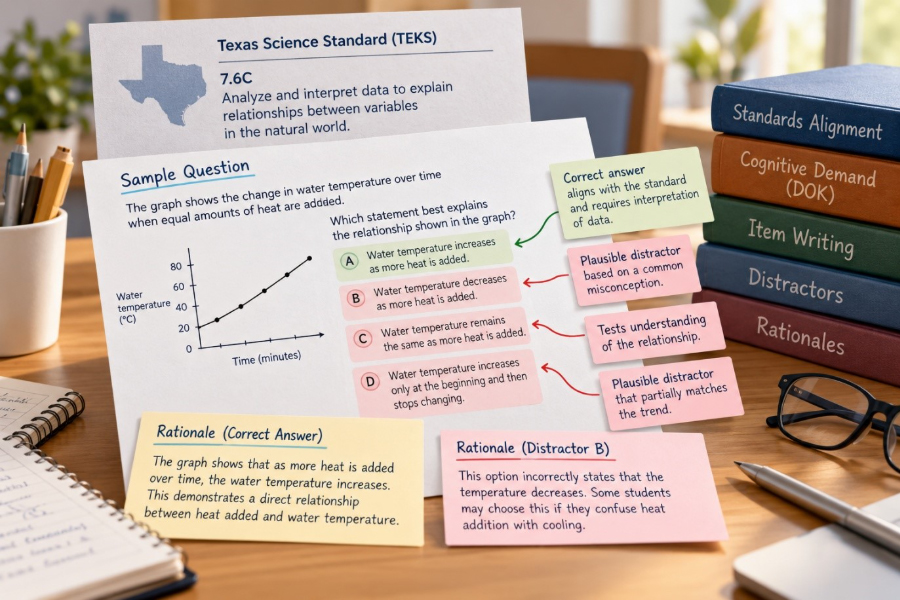
A distractor rationale explains why an incorrect option is wrong and, ideally, identifies the reasoning that might lead a student to choose it. Simply stating “B is incorrect” does not explain the underlying misconception.
For example:
The learner may confuse condensation with evaporation. Condensation occurs when water vapor changes into liquid water, whereas evaporation changes liquid water into vapor.
A complete rationale set should explain both why the correct answer is right and why each distractor is incorrect or tempting.
Question: Which change is evidence of a chemical reaction?
- Ice melting
- Paper tearing
- Iron rusting
- Water boiling
Correct answer: C
- Correct-answer rationale: Iron reacts with oxygen to form iron oxide, a new substance. The formation of a new substance indicates a chemical change.
- Option A rationale: Melting changes water’s physical state but does not create a new substance.
- Option B rationale: Tearing changes the size and shape of paper, but its chemical composition remains unchanged.
- Option D rationale: Boiling changes water from liquid to gas without changing its chemical identity.
Texas publishes rationales alongside released State of Texas Assessments of Academic Readiness (STAAR) questions. Such explanations help clarify the reasoning behind answers and support the review of item quality.
Effective rationales should diagnose misconceptions rather than merely repeat the answer. For example, a student who incorrectly attributes photosynthesis to animals may be confusing how plants produce glucose with how animals obtain energy from food.
These explanations can support teacher feedback, adaptive learning systems, remediation pathways, diagnostic reporting, and item-bank documentation.
Distractors Must Match the Intended DOK
Depth of Knowledge is determined by the complete cognitive task, not just the question stem. The correct answer, distractors, stimulus, and required reasoning can all influence an item’s cognitive demand.
A question intended to assess analysis may become trivial if its incorrect options are obviously impossible. However, making distractors more complicated does not automatically increase DOK.
Assessment developers should also review common item-writing errors:
| Weak practice | Why it creates a problem |
| Obviously implausible distractors | Students can eliminate options without content knowledge |
| One option much longer than others | May unintentionally signal the correct answer |
| Two options with nearly identical meanings | Can create ambiguity |
| Partially correct distractors | May allow multiple defensible answers |
| Unnecessary vocabulary complexity | Measures reading load rather than the intended skill |
| Content beyond grade-level expectations | Takes the item outside its intended scope |
| Distractors unrelated to common errors | Provides little diagnostic information |
| Copying language from the stimulus only into the correct option | May inadvertently reveal the answer |
A useful quality-assurance question is: What student reasoning does each answer represent? If a distractor has no clear rationale, it may need revision.
Assessments Should Preserve the Intended Construct
When assessments include graphs, diagrams, passages, simulations, or other stimuli, every element should contribute to measuring the intended skill without introducing unintended barriers or clues.
Assessment writers and reviewers should check:
- Whether the stimulus provides sufficient information
- Whether it inadvertently reveals the answer
- Whether unnecessary reading increases cognitive load
- Whether accessibility adaptations preserve the intended task
- Whether students need outside knowledge not required by the standard
- Whether multiple interpretations are possible
This review brings together standards alignment, subject-matter expertise, accessibility, instructional design, and assessment quality assurance.
A Practical Assessment Development Workflow
For publishers and EdTech teams working across U.S. state standards, a structured workflow can include:
- Standards analysis: Identify the intended knowledge, skill, cognitive demand, and boundaries.
- Blueprint development: Define item distribution, types, content coverage, and stimulus requirements.
- Item drafting: Develop question stems, stimuli, answer choices, keys, and metadata.
- Distractor design: Create plausible incorrect options based on misconceptions or common errors.
- Rationale development: Explain the correct answer and the reasoning represented by each distractor.
- Subject-matter review: Verify academic accuracy and standards alignment.
- Assessment and editorial QA: Review DOK, ambiguity, grade appropriateness, accessibility, bias, grammar, and answer-choice construction.
- Item-bank preparation: Format approved content for the required learning management system (LMS), assessment platform, spreadsheet, XML, Question and Test Interoperability (QTI), or other delivery format.
This workflow helps teams maintain consistency and identify problems before items enter production.
How AI Can Support Assessment Development
Artificial intelligence can accelerate parts of the workflow by helping generate first-draft questions, candidate distractors, rationale drafts, standard summaries, item variations, metadata, and editorial checks.
However, plausible wording does not guarantee assessment validity. AI-generated items may introduce a second correct answer, use content beyond the standard, misrepresent a scientific or mathematical concept, or create distractors that do not reflect meaningful student misconceptions.
Human review remains essential for verifying accuracy, standards alignment, cognitive demand, and instructional usefulness, particularly for assessments used in benchmarking, diagnostics, and high-stakes educational settings.
Assessment Development Services for Publishers and EdTech Companies
Ankyrin Solutions supports assessment-development projects across science, mathematics, English language arts, humanities, and other K–12 subject areas.
Our services include:
- U.S. state standards alignment and cross-state mapping
- Assessment blueprint development
- Multiple-choice and multi-select item writing
- Technology-enhanced and stimulus-based item development
- DOK classification and review
- Distractor development and correct-answer rationales
- Assessment quality assurance, item revision, and validation
- Accessibility review and metadata preparation
- Item-bank formatting
- Human review of AI-generated assessment content
These services help publishers and EdTech teams develop content aligned with defined learning outcomes and project-specific requirements.
Better Distractors Create Better Assessment Data
A well-designed assessment item does more than identify whether a student selected the correct answer. It provides evidence about what the student understands and where misconceptions may remain.
Strong distractors represent plausible student reasoning, while clear rationales explain that reasoning. Combined with accurate standards alignment, appropriate cognitive demand, and systematic quality review, they help make assessment results more meaningful.
For publishers and EdTech organizations developing assessments across U.S. state standards, the strongest approach combines structured design, subject-matter expertise, careful distractor construction, and human review.
At Ankyrin Solutions, we help teams develop and review assessments built around a simple principle: every item should measure something intentionally, and every answer option should exist for a reason.