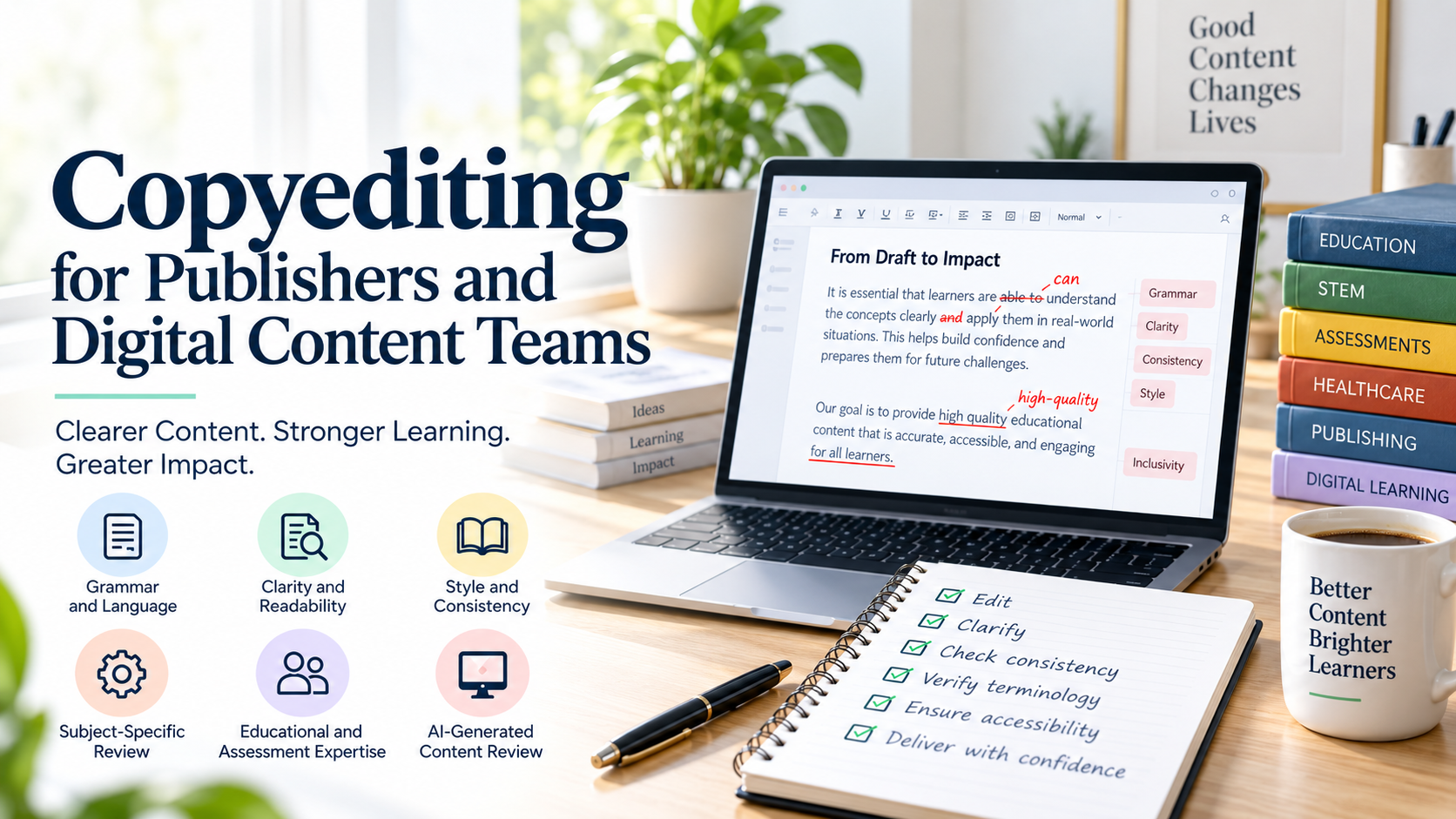
A document can be grammatically correct and still be difficult to understand, inconsistent, factually misleading, or unsuitable for publication. Copyediting services help publishers, EdTech companies, academic-content providers, and digital learning teams turn draft material into clear, consistent, accurate, and publication-ready content.
Professional copyediting goes far beyond correcting spelling and punctuation. It is an important quality-control stage between content creation and publication, particularly for organizations managing large volumes of educational, academic, technical, or digital content.
At Ankyrin Solutions, our copyediting services and editorial QA services support educational, academic, technical, and digital-content workflows. We work with content created by internal teams, external vendors, subject-matter experts, and AI-assisted production systems.
The goal is not simply to make content look polished. It is to make it clear, consistent, reliable, and ready for publication or production.
What is Copyediting?
Copyediting is the process of reviewing and improving written content before final publication or production.
Professional copyediting services may include reviewing:
- Grammar
- Spelling
- Punctuation
- Sentence structure
- Clarity
- Consistency
- Terminology
- Capitalization
- Numerals and units
- Abbreviations
- References
- Headings
- Tone
- Style-guide compliance
- Internal consistency
Depending on the project, an editor may also identify ambiguous wording, factual inconsistencies, missing information, awkward transitions, formatting problems, and terminology that does not match the intended audience.
Good copyediting sits between simple proofreading and deeper content review.
Copyediting vs. Proofreading vs. Content Editing
These terms are often used interchangeably, but they serve different purposes.
| Service | Primary focus |
| Proofreading | Final typographical, punctuation, spelling, and formatting errors |
| Copyediting | Grammar, clarity, consistency, style, terminology, and readability |
| Content editing | Structure, logic, completeness, organization, and overall effectiveness |
| SME review | Subject accuracy, technical correctness, and domain-specific validation |
A project may require one stage or several.
For example, a digital lesson may first go through content editing to improve structure, followed by subject-matter review for accuracy, copyediting for language and consistency, and proofreading after layout.
Understanding these differences helps organizations build a more reliable editorial workflow and choose the right copyediting services for each stage.
Why Copyediting Services Matter for Publishers and Digital Content Companies
When content is produced at scale, small inconsistencies can multiply quickly.
One writer may use US spelling while another uses UK spelling. One lesson may use “Grade 6” while another uses “sixth grade.” A science module may alternate between terms such as “heat energy” and “thermal energy.”
An assessment may also use different instructional language across questions, while a healthcare course may contain correct grammar but inconsistent medical terminology.
Individually, these issues may appear minor. Across hundreds of pages, modules, assessments, or learning objects, however, they can affect the professionalism and usability of the entire product.
Professional copyediting services help maintain:
- Consistency across multiple contributors
- Readability
- Editorial credibility
- Learner experience
- Style-guide compliance
- Terminology control
- Production quality
- Brand consistency
For publishers and digital learning organizations, these are not merely cosmetic concerns. They directly influence the quality and consistency of the final content.
Copyediting Is More Than Grammar Correction
Grammar is only one layer of editorial quality.
Consider this sentence:
The learner should utilize the following process in order to effectively complete the procedure successfully.
The grammar is acceptable, but the sentence is unnecessarily wordy.
A copyeditor may revise it to:
The learner should follow this process to complete the procedure successfully.
The meaning remains the same, but the content becomes clearer and more efficient.
Professional copyediting services can also identify:
- Ambiguity
- Repetition
- Awkward phrasing
- Inconsistent sentence patterns
- Unnecessary jargon
- Vague references
- Overly complex wording
- Abrupt transitions
- Inconsistent tone
The goal is not to rewrite everything. It is to remove unnecessary friction between the content and the reader while preserving the author’s intended meaning.
Clarity and Readability Should Match the Audience
The same idea may need to be written differently for different audiences.
A Grade 5 learner, a university student, a healthcare professional, and an engineer should not necessarily receive the same explanation.
Effective copyediting considers:
- Learner age
- Reading level
- Professional expertise
- Assumed prior knowledge
- Subject complexity
- Instructional purpose
- Delivery format
For educational content, this is particularly important because unnecessarily difficult language can increase cognitive load and interfere with the skill being taught.
A technically accurate sentence is not necessarily instructionally appropriate. Copyediting services for educational content therefore need to consider both language quality and the needs of the intended audience.
Style Consistency Matters at Scale
Large content projects usually involve multiple contributors. Without editorial control, stylistic variation can appear quickly.
Editors may need to standardize:
- Capitalization
- Heading levels
- Numerals
- Dates
- Abbreviations
- Units
- Punctuation
- Terminology
- Instructional verbs
- List formatting
- Question formats
- References
- Citation style
A project-specific style guide helps editors make these decisions consistently.
This becomes especially important in long-running publishing and EdTech projects, where content may be created by different writers, subject-matter experts, editors, and production teams.
Following Client Style Guides
Professional copyediting services should follow the agreed editorial standard rather than individual preferences.
Editors may need to follow:
- A publisher’s house style
- An internal editorial guide
- Chicago-style conventions
- AP-style conventions
- Subject-specific editorial rules
- Client terminology
- Market-specific spelling
- Project-specific formatting requirements
For example, one client may prefer:
while another requires:
One project may use:
Grade 8
while another uses:
eighth grade
Neither choice is necessarily wrong. The important requirement is consistency.
A professional copyeditor follows the established standard and avoids introducing unnecessary personal preferences.
Copyediting Educational Content Requires Additional Attention
Educational content introduces requirements that are not always present in general publishing.
An editor may need to consider whether:
- Explanations are appropriate for the grade level
- Instructions are clear
- Learning objectives are written consistently
- Examples support the concept
- Terminology matches curriculum expectations
- Questions and answers are grammatically aligned
- Rationales match the keyed answer
- Headings and labels are consistent
- Content remains instructionally neutral where required
Educational copyediting services therefore often overlap with instructional design and subject-matter review.
A sentence may be grammatically correct but instructionally weak. An editor working with educational content needs to recognize the difference.
Assessment Copyediting Requires Extra Care
Assessment content is particularly sensitive because small editorial changes can affect the meaning and interpretation of an item.
A copyeditor working on assessments may need to check:
- Whether the stem is unambiguous
- Whether answer choices are grammatically parallel
- Whether only one answer is defensibly correct
- Whether distractors are clearly distinct
- Whether one option is unintentionally longer or more specific
- Whether terminology gives away the answer
- Whether the rationale matches the key
- Whether grade-level language is appropriate
- Whether punctuation and capitalization are consistent
- Whether instructions match the item type
For example:
Which of the following process causes water to evaporate?
contains a grammatical error.
It should read:
Which of the following processes causes water to evaporate?
Assessment editing goes further than correcting the grammatical error. If three options are short nouns and one is a detailed sentence, the difference in structure may unintentionally signal the correct answer.
This is why assessment copyediting requires attention to both language and item construction.
Copyediting Digital Content Is Different From Editing Print
Digital content introduces additional editorial considerations.
A copyeditor may need to review:
- On-screen instructions
- Navigation text
- Hyperlinks
- Buttons
- Labels
- Tooltips
- Feedback messages
- Learning management system screens
- Captions
- Transcripts
- Metadata
- Quiz interfaces
- Video text
- Interactive activities
For example:
Click the button below
may work in one layout but become confusing in a responsive mobile view where the button is no longer physically below the text.
A stronger version might be:
Select Submit to continue.
Digital copyediting services therefore need to account for both language and interface context.
Terminology Consistency Is Critical in Technical Content
Technical and academic content often uses specialized terminology.
A general copyeditor may correct grammar accurately while overlooking a subject-specific inconsistency. Scientific, medical, engineering, and mathematical content may contain terms that appear interchangeable but are not.
A technical editor or subject-matter reviewer may need to check:
- Discipline-specific vocabulary
- Symbols
- Units
- Formulas
- Anatomical terms
- Scientific nomenclature
- Technical abbreviations
- Equation labels
- Process names
This is one reason some projects benefit from combining copyediting services with SME review.
When Copyediting Requires Subject-Matter Expertise
Subject-matter knowledge becomes especially valuable when the content is complex.
A sentence can read perfectly while still being technically incorrect.
For example:
Voltage is the rate at which electrical current flows.
The grammar is acceptable. The technical meaning is not.
A copyeditor without electrical knowledge may not flag the problem. A subject-matter reviewer would.
This distinction matters in areas such as:
- Science
- Mathematics
- Engineering
- Healthcare
- Technical training
- Assessments
- Higher education
- Professional certification content
For publishers and EdTech companies working in these areas, combining editorial review with subject-matter expertise can help reduce the risk of publishing polished but inaccurate content.
Why AI-Generated Content Still Needs Copyediting
AI has made content generation significantly faster. It can produce explanations, summaries, questions, scripts, lesson content, and supporting material in seconds.
But fluent language should not be mistaken for publication-ready content.
AI-generated material may contain:
- Repetitive phrasing
- Generic explanations
- Inconsistent terminology
- Awkward transitions
- Unsupported claims
- Factual inaccuracies
- Fabricated references
- Incorrect examples
- Inconsistent US and UK spelling
- Style-guide violations
- Unnecessary verbosity
- Formulaic language
The issue is particularly important in educational and technical content because an error may not be obvious to a general reader.
AI can produce a grammatically polished sentence that contains a subtle scientific, mathematical, or contextual error.
For this reason, copyediting services for AI-generated content can provide an important human review layer.
A practical model is:
AI for speed. Human copyediting for clarity, context, consistency, and quality.
AI-Assisted Copyediting vs. Human Copyediting
AI can also support the editorial process itself.
It can help identify:
- Spelling issues
- Repeated phrases
- Inconsistent terminology
- Grammar problems
- Formatting differences
- Possible style inconsistencies
This can make first-pass review faster.
However, automated review may not reliably determine whether:
- A sentence is factually correct
- A term is appropriate for the discipline
- An assessment distractor gives away the answer
- A passage matches the intended grade level
- The tone is appropriate for the client
- An instructional explanation is pedagogically sound
- A client-specific exception overrides a general style rule
Human copyeditors provide the contextual judgment required to resolve these issues.
The most effective editorial workflows can combine automation with human review rather than treating the two approaches as competitors.
Copyediting at Scale Requires More Than Individual Editors
Editing ten pages is different from editing ten thousand content assets.
Large publishing and EdTech projects need a repeatable editorial system.
That system may include:
- Master style guides
- Terminology lists
- Editing checklists
- Query logs
- Decision trackers
- Approved samples
- Editor calibration
- Naming conventions
- Content templates
- Consistency sheets
- QA sampling
- Error categorization
- Escalation workflows
Without these controls, different editors may make different decisions about the same issue.
A scalable copyediting services workflow therefore requires both people and process.
Editor Calibration Is Important in Multi-Editor Projects
When multiple editors work on the same project, calibration should happen early.
A useful workflow may involve:
- Reviewing the client guidelines
- Editing a small common sample
- Comparing editorial decisions
- Resolving differences
- Updating the style guide
- Beginning full production
- Reviewing periodic samples
This reduces subjective variation and helps the team make editorial decisions consistently.
For large-volume projects, early calibration can also help identify potential sources of rework before full production begins.
Accessibility Should Also Be Considered During Copyediting
Copyediting and accessibility are different disciplines, but they overlap in important ways.
An editor may identify language such as:
Click the red button on the right.
This instruction depends on color and visual position.
A more accessible version might use the button name instead:
Select Continue.
Editors can also identify:
- Vague hyperlink text
- Unclear headings
- Inaccessible instructions
- Confusing table labels
- Inconsistent terminology in alt text
- Captions that do not match the content
- Language that depends unnecessarily on visual position
Accessibility review may still require a specialist, but editorial teams can identify many language-related issues early.
Common Problems Professional Copyeditors Catch
Professional copyediting services commonly address several recurring problems.
Grammar Errors
Incorrect:
Each of the students have completed the activity.
Edited:
Each of the students has completed the activity.
Inconsistent Terminology
One section uses:
learning objective
while another uses:
learning goal
If both terms refer to the same concept, the project should generally standardize the terminology.
Unnecessary Complexity
Original:
Learners are required to utilize the provided resources for the purpose of completing the activity.
Edited:
Learners use the provided resources to complete the activity.
Inconsistent Instructional Language
One module says:
Click the correct answer.
Another says:
Choose an answer.
Another says:
Select the option you think is correct.
A standardized instruction can improve consistency across the course.
Ambiguous References
Original:
Place it there after completing this.
The sentence may be grammatically possible but difficult to interpret.
Copyediting should remove ambiguity where context allows.
A Practical Copyediting Workflow
A structured workflow helps maintain quality, especially for large publishing and EdTech projects.
1. Project Intake
Review the content type, target audience, required level of editing, delivery format, and client expectations.
2. Style-Guide Review
Study the client style guide, terminology rules, spelling conventions, and project-specific requirements.
3. Sample Edit
Complete a small batch to establish expectations and confirm the editing approach.
4. Copyediting
Review grammar, clarity, consistency, terminology, tone, formatting, and style.
5. Editorial Queries
Flag unclear, contradictory, incomplete, or potentially inaccurate content rather than making unsupported assumptions.
6. SME Escalation Where Needed
Send technical or subject-specific questions to an appropriate reviewer.
7. Consistency QA
Check recurring terminology, capitalization, headings, instructional language, and formatting across the project.
8. Final Review
Verify that accepted changes have been incorporated correctly and that no new inconsistencies have been introduced.
9. Delivery
Return the content in the required format along with queries, tracked changes, editorial notes, or QA reports where required.
How to Measure Copyediting Quality
Editorial quality should not depend only on subjective impressions.
For large projects, organizations may monitor metrics such as:
- Error rate
- First-pass acceptance rate
- Number of client queries
- Rework rate
- Recurring error categories
- Consistency issues
- Missed-error rate during QA
- Adherence to turnaround time
- Reviewer agreement
- Client acceptance
Tracking these measures can help identify both content problems and process problems.
For example, if editors repeatedly make the same correction, the style guide may need clarification. If many queries relate to technical accuracy, the workflow may need stronger subject-matter involvement.
Editorial data can therefore improve the process itself.
Copyediting Should Preserve the Author’s Meaning
A copyeditor should improve content without unnecessarily replacing the author’s voice.
Overediting can create its own problems.
Editors should avoid:
- Changing correct content simply because they prefer different wording
- Introducing a new tone without reason
- Rewriting subject-specific language they do not understand
- Making assumptions about unclear technical content
- Altering assessment meaning
- Modifying established client terminology without approval
Good editing is controlled.
The goal is to improve clarity, consistency, and readability while preserving meaning.
Copyediting Services for Publishers, EdTech, and Digital Content Teams
Ankyrin Solutions provides copyediting services and editorial QA support across educational, academic, technical, and digital-content workflows.
Our services can include:
- Copyediting
- Proofreading
- Editorial QA
- Educational content editing
- Assessment copyediting
- Technical and STEM content review
- SME-assisted editorial review
- AI-generated content review
- Consistency checking
- Style-guide compliance
- Terminology management
- Accessibility-aware editorial review
- Content cleanup
- High-volume editorial production support
We can work with content created internally, developed by external vendors, produced through AI-assisted workflows, or created directly by content-development teams.
Why Publishers and EdTech Companies Need More Than Error Correction
Copyediting is sometimes treated as the final language check before publication.
In practice, its value is broader.
A strong editorial process helps ensure that content is:
- Correct
- Clear
- Consistent
- Appropriate for the audience
- Aligned with the required style
- Ready for production
For educational and technical content, professional copyediting services can also help identify issues that affect learning, assessment quality, accessibility, and subject accuracy.
As AI accelerates content production, structured editorial review becomes increasingly important. More content can now be created faster. The challenge is ensuring that the content remains trustworthy and fit for its intended purpose.
For publishers, EdTech companies, and digital-content organizations working at scale, strong editorial workflows combine clear standards, experienced editors, subject-matter expertise, technology, and quality assurance.
At Ankyrin Solutions, our copyediting services bring these elements together to help transform draft content into accurate, consistent, clear, and publication-ready material.