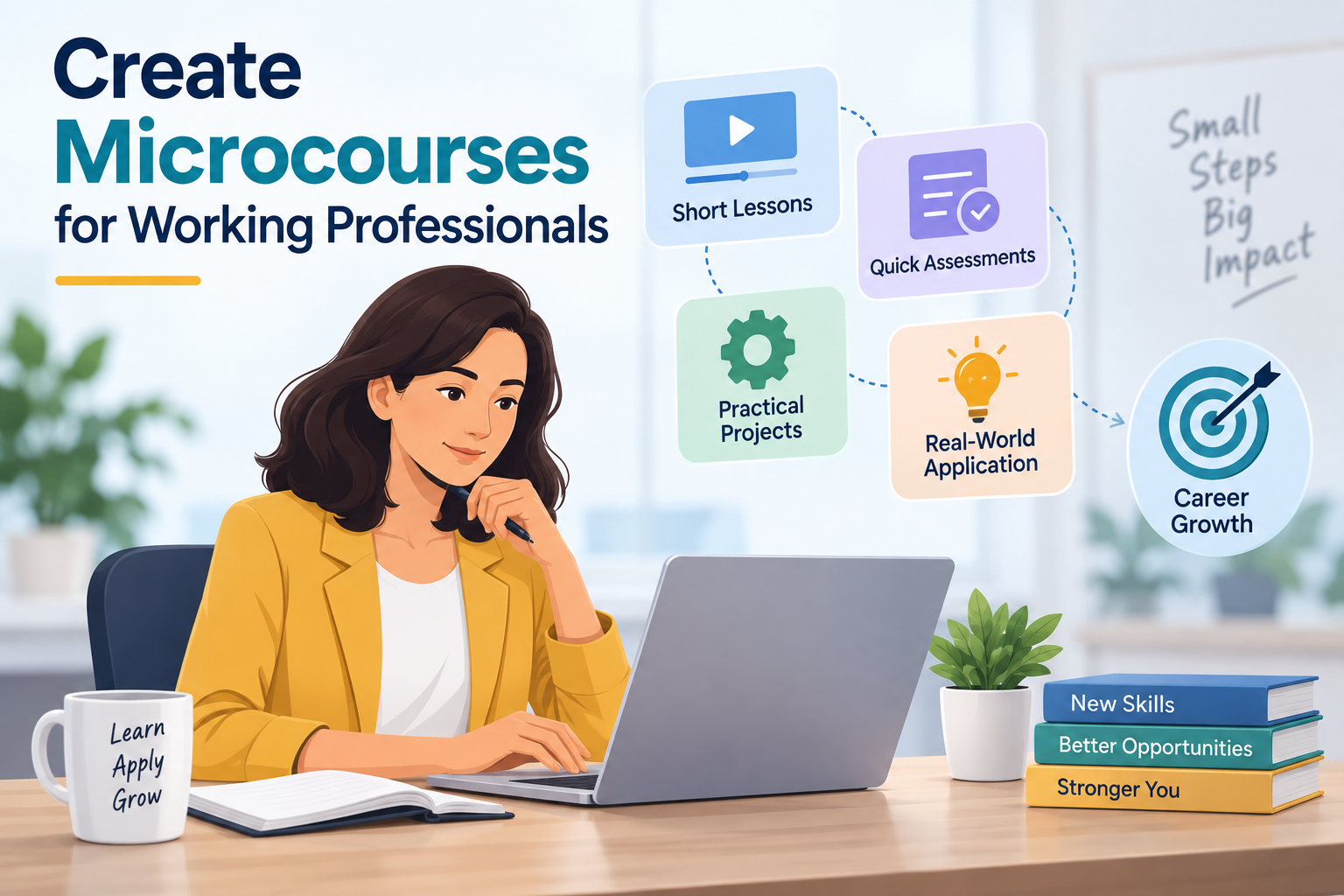
Working professionals rarely need more content.
They need the right content, at the right depth, that helps them perform a task, solve a problem, make a better decision, or build a specific skill.
That distinction is important when designing micro-courses and when organizations create Micro courses for professional learners.
A micro-course is not simply a conventional course compressed into twenty or thirty minutes. Reducing the number of slides or shortening a video does not automatically create effective professional learning.
A well-designed micro-course begins with a narrowly defined performance outcome and builds only the instruction, practice, assessment, and application needed to achieve that outcome.
For publishers, EdTech companies, corporate learning providers, professional associations, universities, and training organizations, this approach can make learning easier to integrate into busy professional schedules while still producing measurable results.
At Ankyrin Solutions, our micro-course and professional learning content development services combine subject-matter expertise, instructional design, assessment development, scenario-based learning, and digital content production to create concise learning experiences that are focused on application rather than content volume.
What Is a Micro-course?
Microlearning and micro-courses are related, but they are not necessarily the same thing.
A microlearning asset may be a five-minute video, infographic, flashcard activity, short simulation, or knowledge check addressing a single concept.
A micro-course is typically a more structured learning experience built around a specific competency or workplace outcome.
For example:
Too broad:
Project Management Fundamentals
Better micro-course:
Identify and Prioritize Project Risks Before Project Kickoff
Another example:
Too broad:
Using Generative AI at Work
Better micro-course:
Write and Evaluate AI Prompts for Customer-Support Responses
The second version in each case gives the course a clear purpose.
The learner should be able to demonstrate something useful after completing it.
Start with the Workplace Outcome, Not the Content
Traditional content development often begins with the question:
What should we teach?
Professional micro-course design should begin with:
What should the learner be able to do differently after completing this course?
Consider a micro-course for new managers.
A weak objective might be:
Understand effective employee feedback.
A stronger performance-oriented objective would be:
Deliver structured feedback that identifies the performance issue, provides supporting evidence, and agrees on a next action with the employee.
The second objective immediately influences the rest of the course.
The learner does not need twenty pages on the history of performance management. They need enough knowledge to understand the feedback framework, see it applied, practice using it, receive feedback, and demonstrate that they can apply it to a realistic situation.
This is one of the most important principles of micro-course development:
Design backward from performance.
When you create Micro courses, the learning outcome should therefore come before the content.
The Content Must Respect the Learner’s Existing Knowledge
Working professionals are not usually beginning with a blank slate.
They bring previous education, job experience, organizational knowledge, assumptions, and established ways of solving problems.
Content designed for them should therefore avoid explaining everything from first principles unless that foundation is genuinely necessary.
For example, a cybersecurity micro-course for general employees may need to explain how to recognize suspicious communication.
A cybersecurity micro-course for IT administrators should operate at a very different level.
Similarly, a financial-analysis course for non-finance managers should not use the same terminology, examples, or assumed knowledge as one designed for finance professionals.
Before developing the course, the content team should identify the learner’s role, experience level, existing knowledge, work environment, common challenges, and situations in which the new skill will be used.
The goal is to remove unnecessary instruction without removing necessary context.
One Micro-course Should Solve One Meaningful Learning Problem
Scope is one of the biggest challenges in micro-course development.
A subject-matter expert may have thirty things they want learners to know. A micro-course may have room for five.
That requires prioritization.
A useful question is:
If learners remember and apply only one thing from this course, what should it be?
That central outcome then determines what stays and what is removed.
A focused structure might look like this:
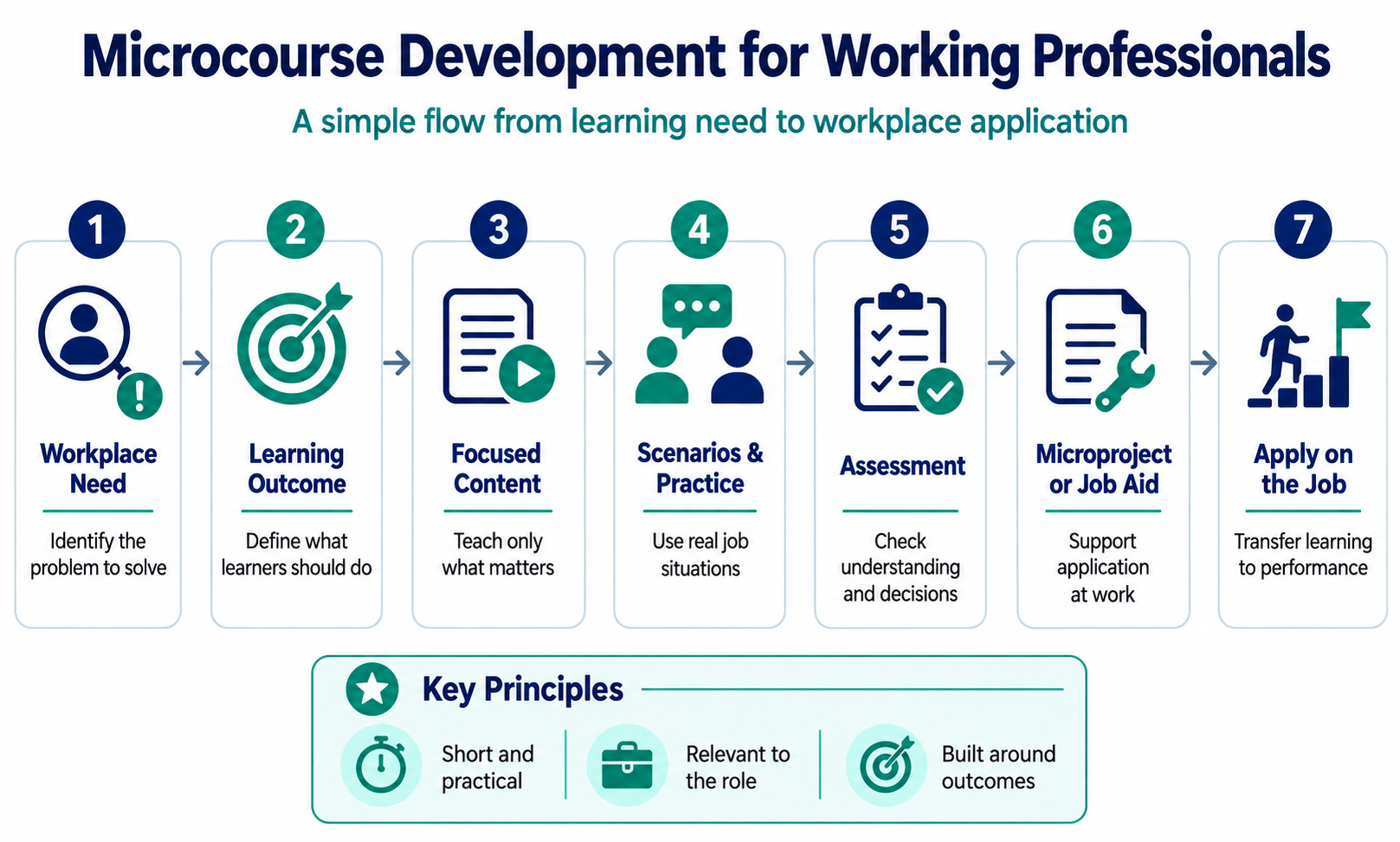
Performance problem → Learning outcome → Essential knowledge → Practice → Assessment → Application
This prevents the micro-course from becoming a miniature textbook.
When organizations create Micro courses, this focused approach helps ensure that the learning experience remains concise without becoming incomplete.
Use Real Workplace Situations
Professional learners are more likely to engage with training when they can immediately see how it connects with their work.
That makes scenario-based learning particularly valuable.
Instead of asking:
Which of the following is the correct definition of stakeholder risk?
a project-management micro-course might present:
Your project sponsor requests a significant scope change two weeks before development begins. The change affects both timeline and budget. What should you do first?
Now the learner has to make a decision.
The question is not merely testing whether the learner remembers terminology. It is asking whether they can apply their knowledge in context.
Scenarios can be particularly effective for areas such as management, healthcare, compliance, customer service, sales, project management, finance, cybersecurity, AI use, and professional communication.
The closer the activity resembles a genuine workplace decision, the stronger the connection between learning and performance.
Content Should Be Short, but Not Superficial
Micro-courses are designed to reduce unnecessary learning time, not intellectual depth.
Some subjects require explanation.
Some require examples.
Some require repeated practice.
And some skills cannot be learned meaningfully from a three-minute video.
The right question is therefore not:
How short can we make the course?
It is:
What is the minimum amount of instruction and practice required for the learner to achieve the outcome?
A good micro-course may therefore combine several short components rather than relying on one continuous lesson.
For example, a twenty-minute learning experience might include a short workplace scenario, a six-minute concept explanation, an expert demonstration, two decision-based activities, an applied assessment, and a downloadable job aid.
Each component has a defined instructional purpose.
Assessments Should Measure Application, Not Just Recall
Assessment design becomes especially important when the stated objective is professional performance.
A learner can score one hundred percent on a terminology quiz and still be unable to perform the corresponding task at work.
For that reason, the assessment should reflect the learning outcome.
If the objective says identify, recognition questions may be sufficient.
If the objective says analyze, the learner should analyze something.
If it says create, they should create something.
If it says demonstrate, the assessment should require performance.
This principle is sometimes referred to as constructive alignment: the learning outcome, instruction, practice, and assessment should all measure the same capability.
For professional micro-courses, assessments can therefore move beyond conventional multiple-choice questions.
A learner might evaluate a client email, diagnose an error in a spreadsheet, select the next action in a management scenario, interpret a dashboard, review a contract clause, modify a project plan, produce an AI prompt, or develop a short recommendation based on supplied information.
Multiple-Choice Questions Can Still Be Valuable
Multiple-choice questions remain useful when they are designed around decisions rather than simple recall.
The difference often comes down to the distractors.
Consider a course on professional communication.
A weak question might ask:
What is active listening?
A stronger question might provide a conversation between a manager and employee and ask which response best demonstrates active listening.
The distractors can represent realistic mistakes such as interrupting with a solution, paraphrasing inaccurately, changing the subject, or responding without acknowledging the employee’s concern.
Now the distractors represent plausible workplace behavior.
The question becomes useful both as an assessment and as a diagnostic tool.
Feedback and Rationales Matter in Professional Learning
In many professional learning environments, an assessment should do more than produce a score.
It should improve the learner’s next decision.
That makes answer-level feedback and rationales particularly valuable.
Instead of simply saying:
Incorrect. Try again.
the course might explain:
This response addresses the employee’s proposed solution before confirming the underlying concern. Begin by clarifying the issue and acknowledging the employee’s perspective before discussing possible actions.
The feedback identifies the reasoning problem and guides future behavior.
For formative assessments, strong rationales can turn each question into another learning opportunity.
Include a Practical Project When the Skill Requires Performance
Not every micro-course needs a project.
But when the intended outcome involves producing, analyzing, planning, designing, communicating, or making a complex judgment, a small applied project can provide stronger evidence of learning than a quiz.
The project should remain proportional to the course.
A thirty-minute micro-course should not end with a ten-hour assignment.
Instead, learners might complete a microproject.
For example, in an AI prompting course the learner could rewrite a weak prompt and evaluate the resulting response. In a project-management course, they could build a simple risk register for a supplied project scenario. In a data-literacy course, they could interpret a dashboard and submit three business recommendations. In a leadership course, they could prepare a feedback conversation using a structured template.
The project demonstrates whether the learner can transfer the concept from instruction to action.
Give Learners Something They Can Use After the Course
A strong professional micro-course should often produce something that remains useful once the lesson ends.
This might be a checklist, decision tree, template, framework, conversation guide, workflow, reference sheet, prompt library, calculator, or job aid.
These resources reduce the burden on memory and help connect formal learning with actual work.
For example, a course on conducting effective meetings could provide a one-page meeting-planning template.
A course on evaluating AI-generated content could provide a five-point review checklist.
A course on incident reporting could provide a decision tree learners can consult when an incident occurs.
This changes the role of the micro-course.
Instead of being something the employee completes once, it becomes part of their performance-support environment.
Completion Rate Is Not the Same as Learning Success
One of the biggest mistakes in digital learning is treating course completion as the primary measure of effectiveness.
Completion tells us that someone reached the end.
It does not tell us whether the learner understood the content, can use the skill, applied it at work, or improved performance.
Micro-course measurement should therefore consider several levels.
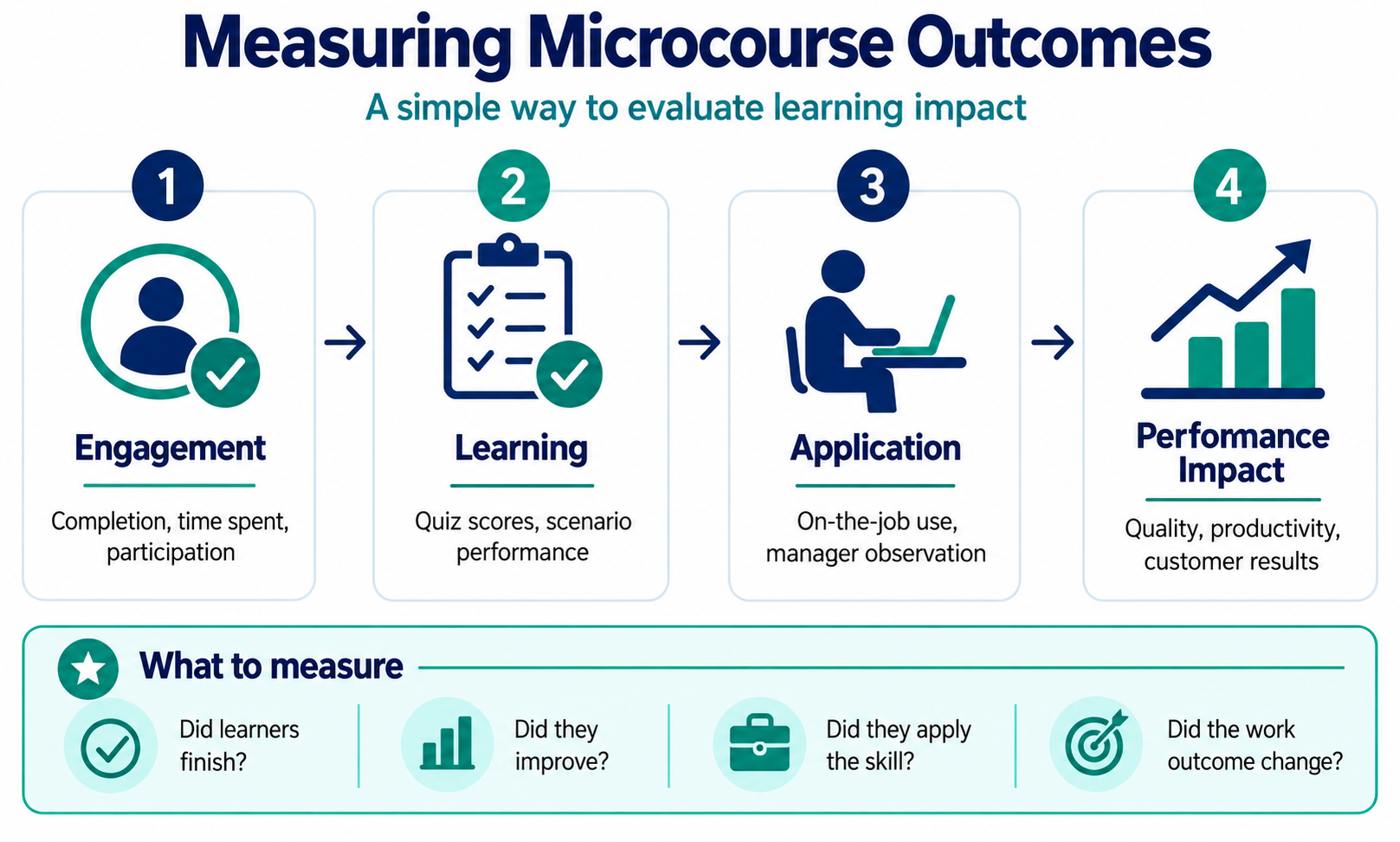
Level 1: Engagement
Did learners participate in the course?
Possible indicators include completion rate, time spent, drop-off points, voluntary participation, and learner satisfaction.
These metrics are useful, but they are only the beginning.
Level 2: Learning
Did learners acquire the intended knowledge or skill?
This can be measured using pre- and post-assessments, scenario scores, performance tasks, confidence ratings, or improvement between practice and final assessment.
Level 3: Application
Did learners use the skill after the course?
This might be evaluated through manager observation, follow-up assessments, submitted work products, learner self-report, system activity, or workplace demonstrations.
Level 4: Performance Impact
Did the learning contribute to a meaningful organizational outcome?
Depending on the course, this could involve fewer errors, faster task completion, improved customer satisfaction, increased conversion, reduced support requests, better compliance, higher productivity, or improved quality.
The closer the measurement is to the original performance problem, the more useful it becomes.
Define Success Before Developing the Course
Measurement should not be considered only after the micro-course has launched.
The outcome framework should be defined during course design.
Suppose an organization wants to create a micro-course on improving customer-support responses.
Before development begins, the team could define:
Current problem: Responses are accurate but frequently too long and difficult for customers to follow.
Learning outcome: Support representatives will write concise responses that identify the customer’s issue, provide the required action, and avoid unnecessary technical information.
Assessment: Learners revise three realistic customer-support responses.
Workplace measure: Quality reviewers track clarity-related errors during the four weeks following training.
Now the course has a measurable purpose.
Without this step, teams may develop engaging training but remain unable to demonstrate whether it solved the problem.
Use Pre-Assessment When Learners Have Different Experience Levels
Professional audiences often have highly variable expertise.
Some learners may already know most of the content.
Requiring everyone to complete the same material wastes time and can reduce engagement.
A short diagnostic assessment can help determine whether learners need the complete course.
For example, a learner who demonstrates mastery might move directly to an advanced scenario or final task.
Another learner may be directed toward foundational instruction.
This creates a more efficient learning experience and reinforces one of the central principles of professional learning:
Do not teach people what they can already demonstrate.
Learning Analytics Can Improve the Course Itself
Assessment results can also provide information about content quality.
Suppose eighty percent of learners select the same incorrect option in a scenario.
That could indicate a widespread misconception.
But it could also indicate that the explanation was unclear, the scenario is ambiguous, or the distractor is unintentionally attractive.
Similarly, if almost everyone answers an assessment correctly without completing the instructional content, the course may be unnecessary or the assessment may be too easy.
Useful analytics can include assessment performance by question, distractor selection patterns, first-attempt versus second-attempt performance, course drop-off, time spent by section, pre- versus post-assessment gains, and follow-up performance.
The course can then be refined based on evidence rather than assumptions.
AI Can Accelerate Micro-course Development, but It Should Not Define the Learning
AI can support many parts of micro-course production.
It can help generate first drafts, scenario variations, assessment questions, feedback, summaries, examples, scripts, and job aids.
This can significantly reduce development time.
However, AI-generated content should still be reviewed for subject accuracy, instructional relevance, professional realism, assessment validity, bias, accessibility, and alignment with the actual performance outcome.
One common risk is creating content that looks educational but does not solve the learning problem.
An AI system can generate ten questions in seconds.
The more important question is whether those ten questions provide evidence that the learner can perform the intended task.
For scalable professional learning, a stronger model is:
AI for production efficiency. Human expertise for instructional judgment and quality.
A Practical Micro-course Development Process
A professional micro-course development workflow can follow this sequence:
Performance problem → Audience analysis → Learning outcome → Content architecture → SME development → Scenarios and practice → Assessment → Applied task or project → Job aid → Instructional and editorial QA → Digital production → Learning analytics
Each stage answers a different question.
What needs to change?
Who needs to change it?
What should they be able to do?
What knowledge supports that performance?
How will they practice?
How will we determine whether they can do it?
And finally:
Did the learning actually produce the intended outcome?
Micro-course Development Services for Publishers, EdTech and Learning Companies
Ankyrin Solutions can support organizations developing short-form professional and adult-learning content across the complete development lifecycle.
Our work can include performance and learner analysis, learning-objective development, micro-course architecture, SME content development, instructional design, scenario-based learning, simulations and interactions, assessment development, distractors and rationales, applied projects, job aids, video and narration scripts, accessibility review, editorial QA, and LMS-ready content preparation.
We can also review and improve existing micro-courses or AI-generated learning content where organizations need additional subject-matter, instructional, assessment, or editorial validation.