Artificial intelligence is changing how publishers and EdTech companies create educational content. AI can generate assessments, lesson material, image descriptions, transcripts, summaries, and alternative text at a speed that was difficult to achieve through traditional production workflows.
For organizations managing thousands of pages, images, assessments, and digital learning assets, this creates an important opportunity to scale accessibility.
But there is also a challenge.
AI-generated accessibility content is not necessarily a learner-ready accessibility content.
This distinction becomes especially important in STEM subjects. A description of an everyday photograph may require relatively little subject knowledge. A description of an electrical schematic, anatomical illustration, molecular model, graph, engineering process, or physics diagram can require considerable interpretation.
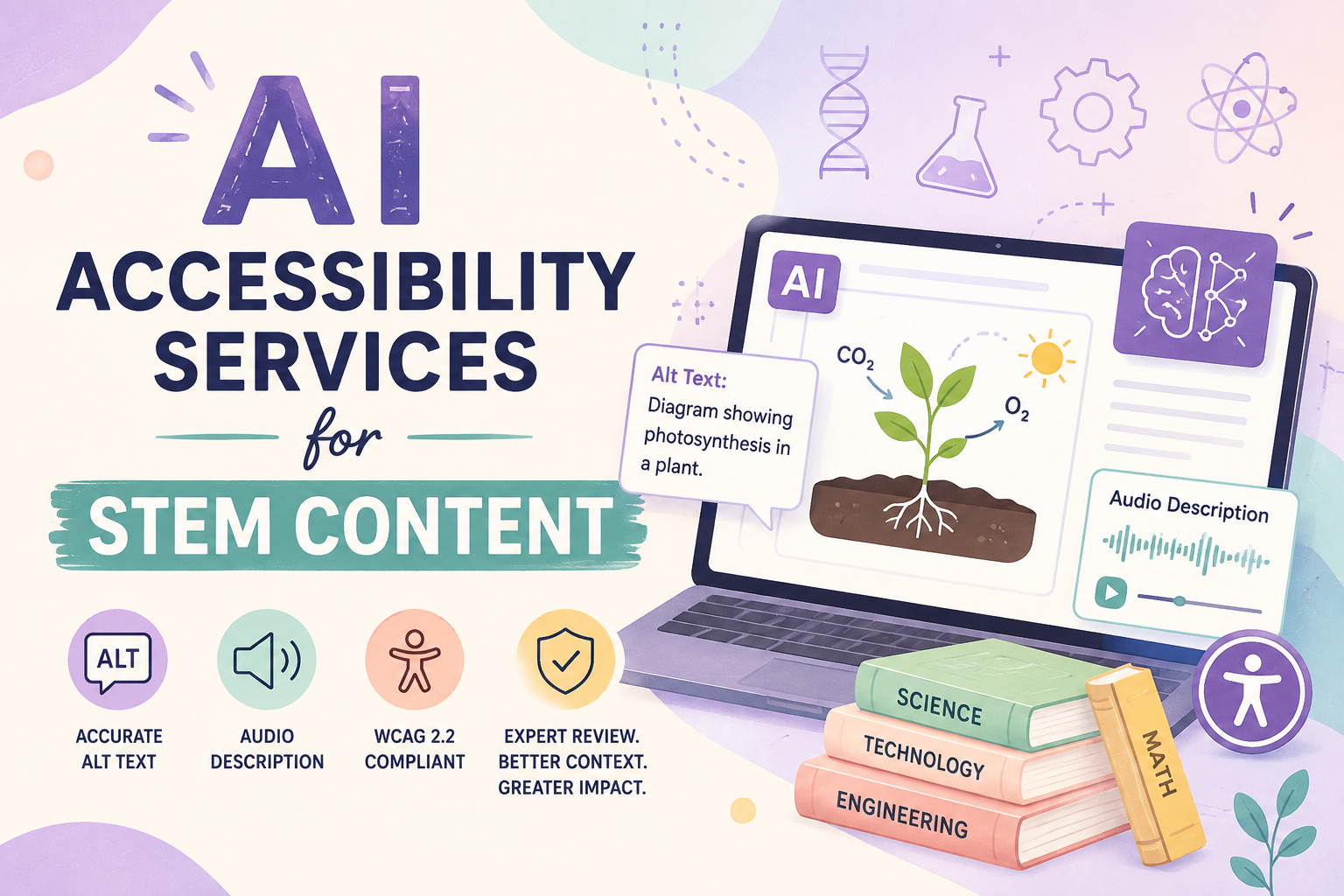
At Ankyrin Solutions, our AI accessibility services combine the efficiency of AI-assisted workflows with human subject matter and accessibility review. We work with publishers, EdTech companies, assessment providers, and learning-content organizations to deliver educational accessibility services, particularly for science, technology, engineering, mathematics, and healthcare-related subjects.
Why AI Accessibility Services Need Human Review
AI is increasingly useful as a first-stage content-production tool. However, accessibility is highly contextual.
The World Wide Web Consortium, or W3C, emphasizes that text alternatives should communicate the information or function represented by an image, rather than merely provide a literal description of what appears visually.
That distinction is particularly important in education, and it’s central to how we approach alt text for STEM content.
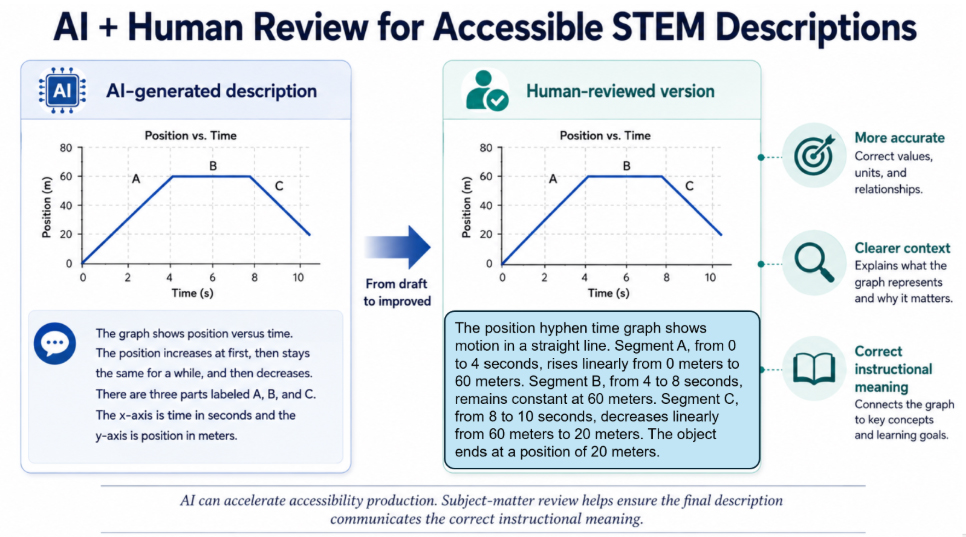
Consider a graph showing the relationship between force and acceleration. Simply describing two lines, labels, and arrows may technically reproduce visual elements without communicating the instructional information a learner needs.
The same issue arises with:
- anatomical and medical illustrations;
- engineering schematics;
- chemical structures and molecular models;
- mathematical diagrams;
- graphs and data visualizations;
- scientific processes;
- maps and timelines;
- interactive assessments;
- technical training material.
AI can identify many of these elements, but it may miss relationships between them, misinterpret specialized terminology, overlook meaningful arrows or values, or include information that should not be disclosed.
That is where AI-generated alt text review by subject-matter experts becomes valuable.
AI-Generated Alt Text Review for STEM Content
Our approach to STEM accessibility services goes beyond checking grammar or rewriting AI-generated descriptions.
We review whether the description actually represents the source correctly.
For example, an engineering diagram may contain flow direction, pressure relationships, component connections, rotational motion, or input-output relationships. A medical figure may contain anatomical structures, measurements, or relationships between body systems. A scientific chart may rely on a trend rather than an individual data point.
Our reviewers evaluate AI-generated descriptions for:
- factual and visual accuracy;
- correct STEM terminology;
- meaningful labels and values;
- directional arrows and process relationships;
- graphs, axes, legends, and data patterns;
- mathematical and scientific notation;
- reading sequence;
- unnecessary visual information;
- unsupported interpretation;
- cognitive load;
- consistency with client-specific accessibility guidelines.
The objective is not necessarily to make the alt text longer.
It is to make it more accurate, purposeful, and instructionally useful.
A simple example
Suppose an AI-generated description says:
Two curves move upward across a graph.
That may be visually correct but educationally incomplete.
A reviewer may need to determine whether the important information is that both quantities increase, one curve rises more rapidly than the other, an intersection occurs at a particular value, or the curves represent different experimental conditions.
The correct description depends on the learning context. That context is difficult to address through automated image recognition alone which is exactly why AI-generated alt text review matters as much as generation itself.
AI Accessibility Services for Assessments Require Additional Care
Accessibility becomes even more nuanced when the visual appears inside an assessment.
The description must provide access to the information required to answer the question without changing the construct being measured.
Consider an activity in which students must identify an electrical or hydraulic schematic symbol. If the alt text simply names the component, the accessibility description has effectively supplied the answer.
The same can happen when AI summarizes the conclusion of a graph rather than describing the data students are expected to interpret.
For assessments, our accessibility review therefore considers questions such as:
- Does the description accidentally reveal the answer?
- Does it give a learner more information than the original visual provides?
- Does it omit information needed to complete the task?
- Does it preserve the intended difficulty?
- Is terminology appropriate for the learner’s grade level?
- Does the description maintain the intended assessment construct?
This makes accessibility review closely connected to assessment design, instructional design, and subject-matter expertise, a core part of our broader AI accessibility services for test and assessment providers. Learn more about our Assessment Development Services.
AI Accessibility Services for Educational Videos
Images are only one part of digital learning.
Educational videos frequently communicate important information visually through demonstrations, equations, animations, gestures, diagrams, experiments, and on-screen text. Audio description therefore needs to do more than describe what appears on screen.
The description needs to identify what a learner cannot obtain from the existing narration.
For example, if the instructor already explains that an object is moving downward, repeating the same information in an audio description adds unnecessary cognitive load. But if an animation visually demonstrates how velocity changes during that movement and the narration does not mention it, that information may need to be described.
Our educational audio-description workflow considers:
- existing voice-over and narration;
- meaningful on-screen actions;
- STEM diagrams and animations;
- equations and labels;
- demonstrations and experiments;
- available pauses between narration;
- instructional relevance.
Explore our Audio Description Services.
Why AI Accessibility Matters More for Publishers
Accessibility is increasingly becoming a publishing-production requirement rather than an optional final-stage enhancement; one reason more publishers are turning to dedicated accessibility services for publishers.
The European Accessibility Act came into application in June 2025 and covers products and services that include eBooks and related digital services. The European Commission describes the legislation as a mechanism for establishing common accessibility requirements across the EU.
Publishing organizations have consequently been strengthening their accessible publishing workflows. Bloomsbury, for example, states that eBooks covered by the European Accessibility Act must be produced with accessibility requirements in mind from June 28, 2025.
Accessibility challenges are also far from being solved across digital content more broadly.
WebAIM’s 2025 analysis of the top one million home pages detected more than 50 million accessibility errors, averaging approximately 51 detected errors per page.
For publishers and learning companies producing content at scale, these figures illustrate an important point:
Accessibility requires a repeatable quality-assurance process, not only an automated check at the end of production.
AI Can Scale Accessibility: Human Expertise Helps Protect Quality
The discussion around AI and education is increasingly shifting from whether AI should be used to how it should be used responsibly.
The U.S. Department of Education has published guidance addressing AI use across educational functions and emphasizes responsible implementation within existing educational requirements.
The same principle applies to accessibility of production.
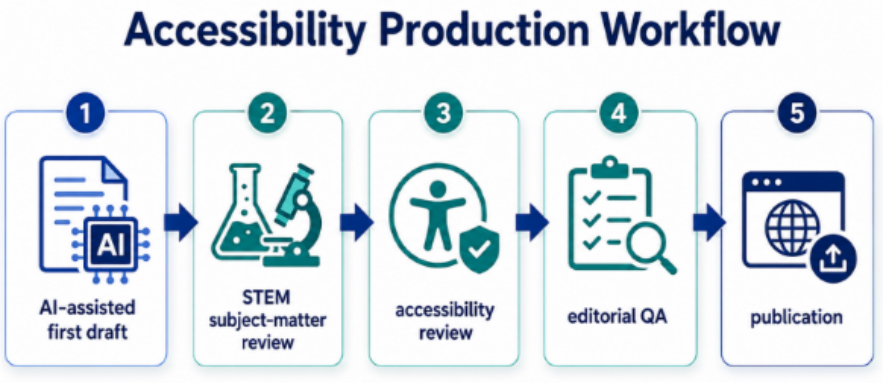
A practical workflow can look like this:
AI helps with throughput.
Human reviewers provide contextual judgment.
For publishers and EdTech companies handling large content volumes, this hybrid workflow can offer a better balance between scale, turnaround time, and quality control- the foundation of effective accessibility services for EdTech teams.
Our AI Accessibility Services for Publishers and EdTech Companies
Ankyrin Solutions supports organizations at different stages of the accessibility-production process. We can work on content created manually, generated through AI, or supplied by another production vendor.
Our services include:
- AI-generated alt text review;
- original alt text writing;
- extended descriptions for complex STEM visuals;
- accessibility QA;
- audio-description script writing and review;
- transcript and on-screen-text review;
- editorial and copyediting support;
- assessment accessibility review;
- consistency checks across high-volume content;
- subject-matter review of scientific, technical, and educational descriptions.
Our team works across educational and technical domains including science, mathematics, engineering, healthcare, assessment, and K–12 learning content. Explore our STEM Content Development Services, learn more about our Assessment Development and Review Services, or Contact Ankyrin Solutions for a pilot AI accessibility services project.
Building Better AI Accessibility Workflows
The future of accessibility is unlikely to be completely manual or completely automated.
AI offers publishers and EdTech organizations an opportunity to process increasingly large volumes of content. But complex educational material still requires decisions about meaning, context, instructional purpose, and learner experience.
W3C guidance itself reinforces the importance of purpose when creating text alternatives: the appropriate alternative depends on what the visual is communicating and why it is being used. For STEM content, that often requires someone who understands both the visual and the subject.
At Ankyrin Solutions, we see AI as an accelerator, not a substitute for subject matter judgment. By combining AI accessibility services, STEM expertise, accessibility review, and editorial QA, we help publishers and EdTech organizations transform machine- generated descriptions into content that is accurate, purposeful, and ready for learners.