In the 1980s, educational psychologist Benjamin Bloom introduced what is now known as the 2 Sigma Problem – one of the most influential ideas in modern learning science.
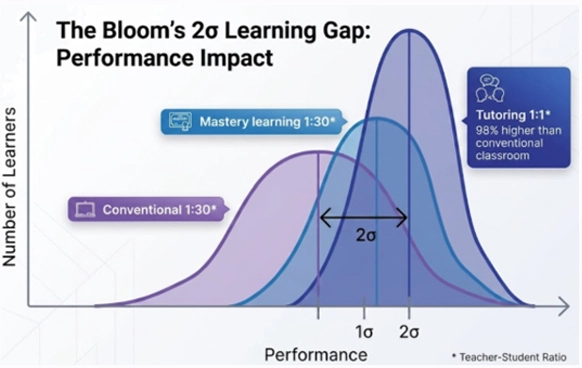
Bloom’s research showed that students who received one-to-one tutoring performed significantly better than those taught in traditional classroom environments. Specifically, the average tutored student performed two standard deviations
(2 sigma) above the average classroom student. In practical terms, this means that a typical student, when given personalised instruction, could perform at the level of the top-performing students in a conventional setting.
This finding was not merely about improved scores – it revealed a fundamental truth about learning: the method of instruction can dramatically influence outcomes, even when content and learners remain the same.
Understanding the Gap
To better understand Bloom’s insight, it is helpful to visualise how learning outcomes differ across instructional models.
In a traditional classroom, student performance tends to follow a normal distribution, with most students clustered around the average. However, with one-to-one tutoring, the entire distribution shifts to the right, indicating a substantial improvement in overall performance.
This shift highlights that the gap is not incremental; it is systemic and structural.
The Core Problem: Why Personalisation Does Not Scale Easily
While Bloom’s findings clearly demonstrate the effectiveness of personalised learning, they also raise a critical question:
Why is one-to-one tutoring not the norm?
The answer lies in scalability.
Classroom systems are designed for efficiency and reach, not individualisation. Educators must work within constraints such as:
- Limited time and attention per student
- Diverse learning levels within a single group
- Fixed instructional pace
- Delayed or periodic feedback mechanisms
In contrast, one-to-one tutoring allows continuous adaptation to a learner’s needs. The tutor can immediately identify misunderstandings, adjust explanations, and provide targeted practice.
This creates a fundamental tension in education: systems that scale tend to lose personalisation, while systems that personalise are difficult to scale.
What Drives the 2 Sigma Improvement
Bloom’s work suggests that the effectiveness of tutoring is not accidental but driven by specific instructional factors. These include:
- Personalised pacing, allowing learners to progress based on their readiness
- Immediate feedback, enabling quick correction of errors
- Focused practice, targeting individual learning gaps
- Continuous assessment, ensuring that understanding is actively monitored
These elements collectively create a learning environment where students are supported at every step, leading to significantly improved outcomes.
Towards a Scalable Solution
When Bloom introduced the 2 Sigma Problem, he also posed a challenge to educators and researchers:
Can we achieve the benefits of tutoring within scalable learning systems?
Today, advances in technology – particularly in data-driven and AI-enabled systems-are beginning to address this question.
Modern learning platforms can now:
- Adapt content and difficulty levels based on learner performance
- Provide immediate, automated feedback
- Recommend targeted practice exercises
- Offer insights that help educators intervene more effectively
While these systems do not fully replicate the depth of human tutoring, they can approximate many of its key benefits at scale. Importantly, the role of the teacher remains central. Technology serves not as a replacement, but as a tool to enhance the teacher’s ability to personalise learning across larger groups.
Conclusion: From Insight to Design Challenge
Bloom’s 2 Sigma Problem is more than a research finding-it is a design challenge for modern education systems. It compels educators, institutions, and EdTech providers to rethink how learning is structured and delivered. The goal is no longer simply to distribute content efficiently, but to create systems that:
- adapt to individual learners
- provide timely and meaningful feedback
- support continuous improvement
Bloom identified the gap decades ago.
Today, with the convergence of pedagogy and technology, we are closer than ever to addressing it.
The key question now is not whether personalised learning works, but:
How effectively can we design systems that make it accessible to all learners?